
Excavating King Arthur: a romp to Glastonbury

Revisiting Stonehenge
It is historically inevitable that there should appear, in the town of Tintagel on the stormy coast of Cornwall, a car park named King Arthur, a launderette named Launcelot and a lottery draw machine named Merlin. After all, Celtic mythology and Tintagel tourism have it that the heroic chieftain who saved Britain from Barbarians in 12 great battles was brought forth into the world from Merlin the Enchanter’s sea cave at the base of Tintagel Castle.
And it is fitting that County Somerset, which claims Camelot and Arthur’s burial place, should engage County Cornwall in endless blathering about which is “the real King Arthur Country,” thus provoking a plethora of Arthurian theories, archaeological disputes, pretenders to the reincarnated King, and various Knights of the Round Table restos and bars.
But I’ve decided to start my quest for King Arthur places and lore with a return to Stonehenge, the 4,000-year-old stone circle on the Salisbury Plain.
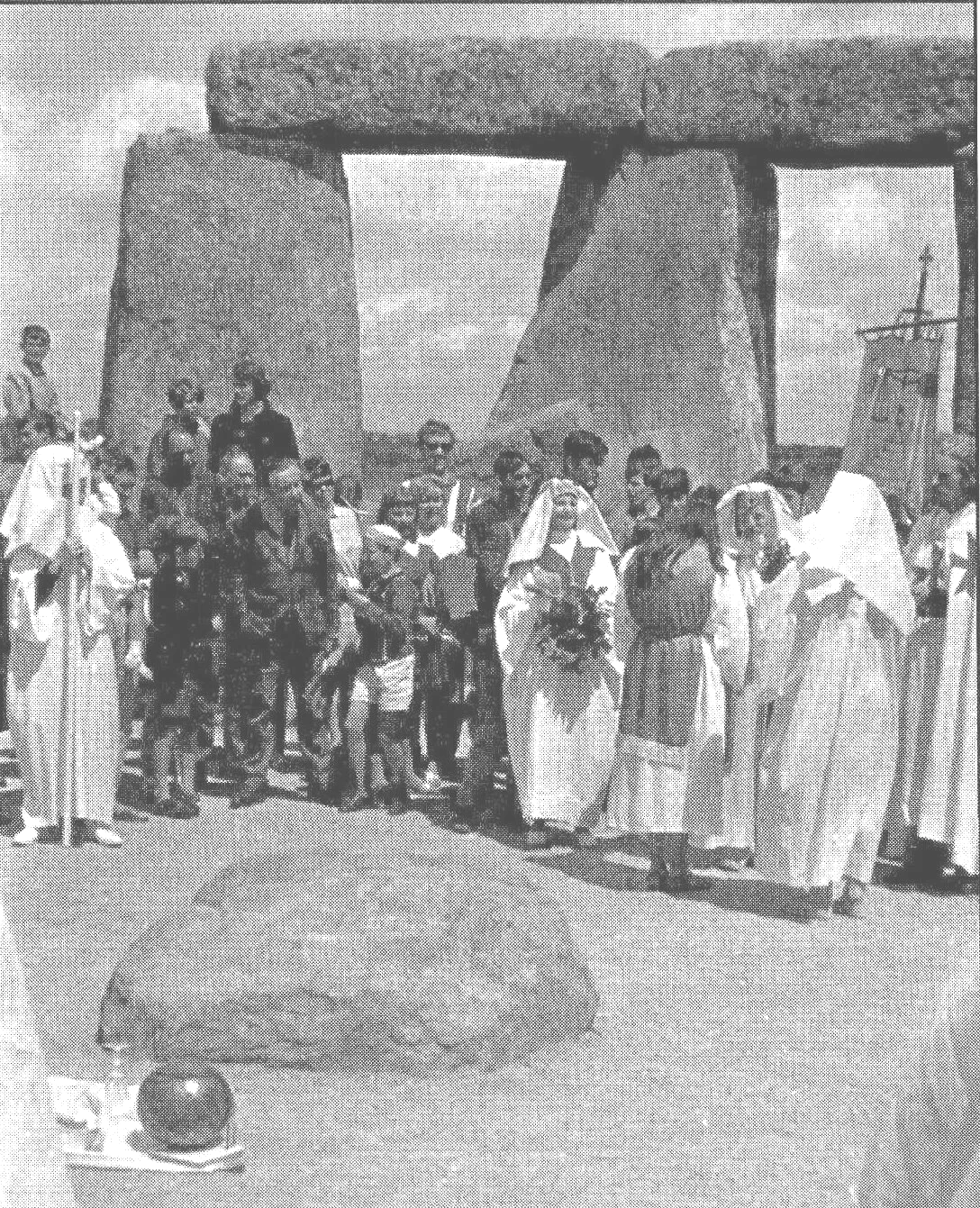
Nancy Lyon at the 1968 Summer Solstice Druid rites at Stonehenge
It is mid-afternoon when I arrive at Stonehenge. I have never seen these megaliths in broad daylight. They seem smaller than they’ve loomed in my memory. The play of dark cloud and flashing sun on the old sarcen stones and lintels makes them appear to move, drifting me back to that Midsummer’s Eve of 1968 when they cast their Celtic spell over me.
In June of 1968 I came to London to spend the summer interviewing West End drama critics for an Indiana University thesis on English theatre criticism. I landed at Heathrow on the morning of June 21st, and for some reason thought of the crotchety old English lit prof named Decan I’d had, who had a thing for the old “Oak-Knowers,” the Druids. I hardly expected to find any Druids in London, but I looked under “D” in the London phone directory anyway, and was startled to find a listing for the Druid society.
The next thing I remember, I was climbing aboard a bus loaded with urban Druids enroute to the Salisbury Plain to celebrate the annual Midsummer Solstice rites at Stonehenge. By 2 a.m., jet lagged out of my mind, they had me dressed in a long white gown, groping slowly through the fog in a long chilly procession to the giant stone circle. I did my duty, bearing a bowl of soggy sacrificial bread crumbs past the Heel Stone and the Slaughter Stone, and around the North Barrow to the Station Stone, where I waited to greet the dawn of the Midsummer Solstice.
I’m really glad I have my photos of those Druid rites, because Stonehenge is roped off to visitors now. In the late 70’s those Midsummer’s rites got to be a free-for-all, with tents and teepees littering the Salisbury Plain, mobs of unclad hippies scampering over the stones, graffiti artists scribbling obscene petroglyphs, and vandals chipping away bits of souvenir monolith. Today the A303 Motorway flies by the old stones without a blink, but they make a startling vision by the side of the road. And their presence still evokes an aura of Celtic mystery and the legendary persona of King Arthur.
King Arthur’s magic sword
Excalibur was the name of King Arthur’s magical sword, of course. It was the Lady of the Lake, clothed in white samite, who rose up out of the magical waters on the Isle of Avalon, held aloft the flashing sword, and bestowed it upon him. (In the Monty Python version, it was some watery tart who threw a sword at him.) Avalon was the island of sacred apple orchards inhabited by a race of female enchantresses. After Arthur’s death at the gruesome Battle of Camlann in 539 AD, his body was taken to Avalon, Ynis Witrin, the “Isle of Glass” where no hail, rain or snow have ever fallen. And where his soul was housed in a glass castle.
Did Avalon ever really exist? In Arthur’s day the Glastonbury Tor was actually an island in the sea of the Bristol Channel. In a ten-mile wide circle around it, features in the landscape appear to form a Zodiac, which some say was the original “Round Table.” And excavations in 1190 at the Glastonbury Abbey unearthed a stone slab buried seven feet down, and a lead cross engraved with the inscription:
Hic Jacet Sepultus Inclytus Rex Arturius in Insula Avallonia: Here lies buried the renowned King Arthur in the Isle of Avalon.
In a hollowed-out tree trunk the Abbey grave diggers found the bones of a tall man with a bashed-in skull, and smaller female bones and locks of yellow hair. On the tree trunk was scratched the name Guinevere.➤→➤→➤
Broken reverie
Hailstones! The brooding sky over Stonehenge has suddenly erupted in an icy pelting shower. Nothing like nasty nails of ice to punch holes in a reverie. I run for cover into the gift shop, warming myself among the Stonehenge sweatshirts and baseball caps. Then I’m back on the A303 headed for Glastonbury, where, if it is really Avalon, it should not hail.
The Glastonbury Tor
From a distance, the Glastonbury Tor and its ruined tower look like a lone breast popping out of the horizon. It is a conical-shaped hill rising 520 feet straight up from the Somerset Levels, over a small market town of 9,000 colorful inhabitants. It is a small hill with a giant mythology. It is threaded with earthen ridges in a circular maze pattern which may date from 3,000 B.C. It has been called many things: a Druid initiation center; Caer Sidi, the Celtic fairy king’s glass mountain’s secret passage to the underworld; a 5th century hill fort where King Melwas of Somerset held Queen Guinevere prisoner; a convergence point of earth ley lines, (energy lines running through the earth like acupuncture meridians in a human body), the Castle of the Holy Grail; and a hot spot for flying saucers.
Climb to the top of The Tor, where the wind screams through the ruins of the 14th century monastery tower of St. Michael the Dragon Slayer, and you feel why it has drawn pilgrims through the ages. The views of the Mendip Hills and the Vale of Avalon, which were once part of the Kingdom of Dumnonia, are exhilarating. But the summit of this bald mound has an eerie presence. After the Dissolution of the Glastonbury Abbey by King Henry VIII in 1539, the old Abbot Richard Whiting and two of his monks were dragged to the top of the Tor by Oliver Cromwell’s men. Whiting was drawn and quartered, and his head lopped off and stuck on the Abbey gate.
Biblical legends
The town of Glastonbury has been a magnet for pilgrims and seekers for long ages before the bones of “Arthur” were said to have been uncovered here. But since that day, Glastonbury and the George and Pilgrims Hotel (circa 1475 and still good for a pint) have been flooded with visitors to Arthur’s grave and other sacred sites.
According to the legends contained in the apocryphal Evangelium Nicodemi, Jesus came to Glastonbury as a boy with his great uncle Joseph of Arimethea, who was a sea-faring merchant on a tin-trading expedition. After the Crucifixion, Joseph was imprisoned for many years, until finally released by Emperor Vespasian. In the year A.D. 63 Joseph of Arimethea returned to Britain, bringing with him the Holy Grail of the Last Supper and the spear with which Longinus had wounded Jesus.
Joseph founded the world’s first Christian church at Glastonbury, and buried the Holy Grail at Chalice Hill, the “Cauldron of Cerridwen” of ancient Celtic myth. The researcher David Young goes even farther, to say that Jesus lived in Glastonbury as a boy, and that the Virgin Mary came as well, and was buried in A.D. 48, in St. Joseph’s Church. And at least one Arthurian theory contends that Arthur and his father Uther Pendragon are direct descendants of Joseph of Arimethea.
Glastonbury’s New Age pilgrims
As for New Age pilgrims and Merlins, Glastonbury is full of them. Dowsers and healers, witches and Druids, geomancers and necromancers, mediums, monks and meditation masters—they come and go in this town with as many layers of beliefs as an archaeological dig, where it’s more usual to wonder about your past lives than the one you’re in.
The buzz in the air is about sacred egg stones, horoscopes and healing wells, magical swords and crystals, and inexplicable shafts of light. Rainbow-colored shops sell New Age doodads like divining rods, amethyst massage wands and crystal balls, and copper pyramids to meditate in; aromatic oils and herbs to sniff and smear over your body, and tomes covering Arthur to Zarathustra. A sign in a café begs: Please don’t bring in sticky lollies, drippy drinks, or other droppy things, and shop notice boards are tacked full of announcements:
Used Kirlian Camera To Photograph Auras, Only £790
Teletherapy machine for sale, like new
Spiritual healing for animals—send a snapshot of your pet, or a snippet of fur, or whisker, or feather, and a self-addressed stamped envelope…
Please help—50 homing pigeons need a retirement home, no racing…
Chakra ceremony—tools for personal and planetary ascension…
A haze of incense hangs over the town, and every week another New Age pagan arrives, claiming to be the reincarnated King Arthur, or Uther Pendragon, or Merlin or Guinevere. Wandering through The Glastonbury Experience, a small mall of hallucinogenic boutiques, I poke my head inside Wildwood Gems, a lapidary shop perhaps designed by an elf. A tall booted man with tidal waves of red hair is eyeing an emerald. Sensing my curiosity, he turns to me with a knowing air. “There are jewels and gold buried around here that are much more valuable than this,” he says, “—along with the 17,000 ounces of gold that were removed from the Glastonbury Abbey before the Dissolution.” And then he introduces himself as “Lifus.”
“Lifus Is that a Norwegian name?”
“No, it was given to me by three different ghosts that I helped. It means ‘Life Anew’ or ‘Flight of the Eagle.’ As well as being a speleologist, songwriter and musician, I’m a ghostbuster,” he says casually. “Sometimes the spirits I contact help me with information. I have a sword that I dug up. It’s about 2,000 years old, and is encrusted with enough jewels and yellow and pink gold to buy two houses.”
“But shouldn’t you take it to a museum?” I ask, challenging the veracity of this claim, and suspecting it’s a New Age relic with fake stones.
“The police have been wondering about it, but they’ve got to prove that I’ve got it. It’s not in my interest to part with it now, because it will lead me to more treasure. I also have a 2,000 year old Caduceus, the magical air wand with the wing at the top of two coiled snakes, that helps me with my work as well.”?
“Which is what, exactly?”
Ghostbuster hides his jewel-encrusted discovery from the police
Lifus meanders into a monologue on the mystical significance of swords. “Swords are what it’s all about,” he says. “I’m a member of the Essenes, a secret order that only broke cover in 1928,” he explains. “There are only 70 of us actually initiated, and I have the great honor of being the Sword Bearer in that society. The Heir-apparent to the throne of Qatar has just ordered us to make a set of swords for him. He is a very good friend of mine. He wants me to research his ancestors’ most famous swords and make reproductions based on the originals.
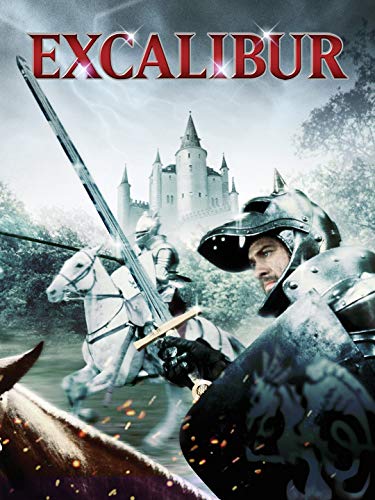
“WORKING AS A FILM EXTRA IN JOHN BOORMAN’S EXCALIBUR
In 1973, seven years after my Druidic “initiation” at Stonehenge, I discovered Irish traditional music and was inspired to build a medieval wire-strung harp and pack off to Ireland. There, in an old Druid forest an hour’s drive from Dublin’s Fair City, I was to meet up with King Arthur. Not the real King Arthur, but the actor Nigel Terry, who was playing King Arthur — in the film Excalibur, John Boorman’s 1981 answer to Sir Thomas Malory’s 1485 Le Morte d’Arthur. as a lady-in-waiting movie extra
I had been busking with my harp on St. Stephen’s Green one May morning when I met Jeremy Johnston, a brawny Saxon lad from Detroit. He had discovered that foreigners could survive in Dublin with a 50 pence Woolworth’s photo and an Actor’s Equity card, easily procurable for a £5 membership fee. He was earning about £18 for a 15-hour day as one of Arthur’s Knights of the Round Table (good work when you could get it), and suggested I might, with my harp, get into the production as well.
I went straight to Woolworth’s, then to the offices of Actor’s Equity and the man in charge told me to show up the next morning at 6:00 a.m.—no harp necessary—to meet the bus which would take all of us extras to a forest deep in the Wicklow Mountains.
The first day on the set, the costumers spent hours dressing me as a court lady-in-waiting in a long medieval trailing gown. The next day I was a peasant in rude burlap sackcloth. (I knew what it was like to go from riches to rags, but extras had to changes lives and costumes in a flash.) It was a great week. We were fed well and often, and most of the time just hung around the forest and gabbed.
Being in on the making of Merlin (as the film Excalibur was originally called) was like watching Monty Python and the Holy Grail, 1974. It was hilarious to hear the medieval “monk” standing next to me (who was really a used tire salesman from Ballyfermot) cursing and swearing in broad Dublinese, and to watch the antics of the knights, who, when the cameras weren’t rolling, amused themselves by trying to stand on their heads in full suits of stage armor.
One day the tech crew brought in several buckets of “Kensington Gore” to prepare the scene for a bloody joust in the forest. As the camera rolled, the stunt men playing King Arthur and the Black Knight galloped full speed toward one another, when Arthur’s lance caught in a tree branch and nearly yanked him off his steed. They shot the scene at least five times. That lance just kept getting stuck in that tree, until someone came and chopped off the offending branch.”

“So you make swords—and fake originals?”
After a grave pause, Lifus says “There are very serious things afoot in Glastonbury. Avalon is coming back to life. That movie The Highlander—reincarnated lives, histories, past and present colliding—is what it’s all about. It’s so to the point it is unreal. My musical agent in London, Her Highness the Princess Ali Khan of Pakistan is helping me with my album Angel Isle, the story of spiritual activity in Avalon since Jesus. In it I release two secrets of the Church, and woe betide me when they realize what I’ve done.”
Lifus offers to show me his excavated treasure, but I think it might be risky, and I have a rendezvous at the Abbey. After thanking him for his esoterica, he says “Well I like to help people. Two women from Minnesota have been visiting me the past few days. I’ve given them lots of information. And they’ve taken one of my songs back to the States, to try to get it released in Indianapolis.”
Walking back down High Street, wondering if Lifus is brilliant or crazy or both, I stop in the Gothic Image Bookshop to have a browse. The Gothic Image, which publishes guides and histories of the area, also organizes tours of Glastonbury’s hallowed places, including The Tor and Wearyall Hill, Chalice Well, Gog and Magog, two old ancient Druid oaks, and the Glastonbury Zodiac. Jamie George, who leads many of the tours, is shelving some new books. I joke that Glastonbury seems like a New Age Zoo.
“No—” he says with a mischievous arch of the eyebrows “—it’s like living in a pack of Tarot cards.”
Glastonbury Abbey
Glastonbury Abbey, “grandly constructed to entice the dullest minds to prayer” was once the largest in Europe, if not the world. According to the ancient science of gematria, the study of the earth’s energy currents, the Romanesque Abbey is linked to the center of Stonehenge by a ley line. The custodian of Glastonbury Abbey, Brigadier David Morgan, is delighted to give me a tour through the magnificent ruins. They cover an area of 36 acres.
We tromp through the misting rain, over the magnificent distance of 580 feet between the ruined nave and the bell tower, and then retreat to the shelter of the 14th century Abbot’s Kitchen. Its vaulted dome roof, designed for ventilation, is now exploited for its acoustics. Brigadier Morgan tells me about the night some New Age monks snuck inside it, locked the door, and proceeded to bang on drums and make awful wailing noises.
“It happens quite often,” he says with mild exasperation. “One night we caught some weird Buddhist sect from across the road meditating inside a copper-tubing pyramid they’d smuggled inside.” (Probably the same pyramid I’d seen in the shop window at #13 Market Street.) “It looked like something from outer space. We like to maintain the Abbey as a sacred Christian site. But it’s not a prison camp, and anyone who’s reasonably athletic can get inside.”

We stop for a contemplative moment at the simple plaque commemorating the excavation of the said bones of King Arthur. (The original spot where the grave was discovered lies 50 feet from the south door of the Lady Chapel.) David likes to believe in the Arthur-Guinivere story, although some Arthurians contend that the bones were a hoax perpetrated to attract pilgrims and rebuild the Abbey’s coffers after its destruction by fire in 1184. On April 12, 1278, King Edward I and his young Queen Eleanor made a pilgrimage to see the bones wrapped in silken cloth and placed in a marble tomb in front of the High Altar. But the tomb has since been destroyed, and the current Mayor of Glastonbury Brian Henderson calls the Arthur and Guinivere bones discovery “a load of rubbish—a great con story.”
Nancy Hollinrake, known locally as the “town archaeologist,” believes in the mythical Arthur, not the man. “Anyone who tries to nail Arthur down to the time span of an active man’s adult life is doing the whole body of Arthurian material a terrific disservice,” she says ardently. “ A myth is a story of the gods and demi-gods and it is far more important than any one individual.” Nancy, who obtained her degree in archaeology from the University of York, adds “How can there be bones? Arthur didn’t die, did he? He sleeps in the hollow hills, wounded in battle then taken to Avalon and put to sleep in a glass house—so why would there be bones?”
Nancy Hollinrake is a down-to-earth sort of woman keen on presenting Glastonbury as a town of museums, rather than New Age flakes. We met in the old 15th century Tribunal at No. 9 High Street where Glastonbury’s Tourist Information Center is housed (and serviced by an information officer named Arthur—Garfitt). Nancy led me upstairs for a tour of the Glastonbury Lake Village Museum. Its artifacts date from the era around 400 B.C. when Glastonbury was only a lake settlement of mud and wattle huts on stilts, and the area was known as Sumersaeta—Land of the Summer People. It is the best preserved Iron Age site in the whole of Europe, Nancy says. “Its inhabitants were remarkably skillful. Look at this Iron Age safety pin, Nancy. Recently I met a young monk on his way from Asia to visit his family in the States, saw it and cried, “Oh my God! My family became terrifically wealthy by patenting the safety pin!”
Later, Nancy invites me for a drink to meet her husband Charles, a consultant archaeologist who believes in Arthur, the man. We start with ales at the Who’d ‘A’ Thought It? on Northload Street. This cheery pub/restaurant/hotel at the end of the town, warmed by a piano, a coal fire and lively chatter, is a whimsical memorabilia museum. The ceiling is papered with old commercial signs and hung with antique tennis and squash rackets, cricket knee pads, old cross-country skis, fishing poles, and harpoons. But in its last incarnation, it was something else.
Only hours before, I had stopped in at the music shop, and owner Gary Crowley, from County Cork, had been inspired to describe the pub as it existed before. With the ferocity of a long-winded Gaelic curse, he called it the roughest, meanest, nastiest, dirtiest, scruffiest, horriblest, uncouth, vulgar, male, chauvinist, piggish, noisiest, smuttiest, grottiest pub you could possibly find. Then quickly said that since Bill Knight (as in shining armor) bought it and completely renovated the place, its “ethos” had changed.
¯After listening to Nancy and Charlie’s friendly bickering over mythical and manly Arthurs, we carry on to The Rifleman’s Arms on Chilkwell Street for bracing pints of cider. (Glastonbury is prime cider-making country—another hint at Avalon’s “Isle of Apples”?) The Rifleman’s is the very pub I’ve been told to avoid—“a rough crowd of warring bike gangs and scruffy New Age travellers.” But it’s the Hollinrakes’ local cider house and Nancy effuses over the rich bouquets of the various “designer ciders” made from apples specially planted for the cider’s tastes—from dry to sweet—and each taken from a different orchard.
It’s a rowdy zany night. Nancy introduces me to members of The Reapers and The Necromancers bike clubs as a journalist who’s come looking for Avalon and Arthur. Then it’s a free-for-all of jokes, puns, slams and jibes. Poor Arthur is laid out on the bar counter and disemboweled by public autopsy. New Age wand-wielders who shop at The Glastonbury Experience battle it out for conversational preeminence with New Age sword-wielders who call it The Ghastly Experience. Last week someone pointing a crystal wand walked into a shop and the owner screamed “No—don’t shoot! I don’t have any money and my children need me!” Glastonbury is godly. Glastonbury is goofy. And Avalon is really Babylon.
Babble on… Avalon really existed, yes, but now it’s just a shoe store… a tire works… a car park… a rugby team. I can hardly hear myself think in this shouting match of cynics and mythologisers. But Will Vaughan is sitting close enough to hear me shout for a “?Kalibur”—the non-alcoholic beer made by Guinness—and then I end up telling this blonde frizzy-haired young poet about my screen debut in the Boorman film. “Look for me at the joust in the forest,” I say. And he says, “Oh you’re the one I’ve been dreaming about all these years!”
Will really believes the story about the bones of Arthur and Guinevere, and tells me that they unearthed the actual bodies of the lovers, perfectly preserved, until a monk touched them and they turned to dust. While Will is waxing romantic, some of the bikers are trying to show me the old English game of shove-ha’penny, a kind of hockey played with half-pence on a slate board.
The ha’pennies are the hockey pucks, made slippy-slidey with arrowroot powder, and you use your finger as a hockey stick. Neat. But I can’t help noticing that these bikers I’ve been warned about don’t look that tough. Nancy says it’s a club of guys who ride bicycles and make long-distance trips with them. “Oh where do you go?” I ask. “Well, nowhere, really,” says a thin chap with thick spectacles. “You see, we don’t actually go anywhere, because we don’t own bicycles.”

I do not see. But it is no more confounding than anything else I have heard this night. Perhaps these men pretend to go on long bicycle expeditions just to fool their wives, so they can go binging in the pub. I do not care to ask. I’m thinking that it’s probably time to leave the bones of Arthur in peace and head for Tintagel on the moody coast of Cornwall.
On my way to Tintagel, I stop in the tiny village of South Cadbury to explore some more Arthurian geography. Cadbury Castle, 11 miles from Glastonbury, isn’t a castle at all but an astounding 500-foot high Iron Age hill fort, which many believe to be the site of King Arthur’s Camelot. Excavations on the site in the 1960’s revealed the remains of a gatehouse, a cobbled road and the foundations of a large timber hall dating from 475 to 550 A.D., the Arthurian epoch. I hike up to the crest for a view. On a clear day you can see the Glastonbury Tor, but today is foggy and I pace slowly around and around the steep grassy cliff edge, with my ear cocked for the lost echo of thundering hooves and clashing armor.
The Bodmin Moor is the wildest stretch of moorland in Cornwall. Legend has it that the Dozmary Pool was the bottomless lake into which the sword Excalibur was plunged upon Arthur’s death. In the movie Excalibur, the Lady of the Lake floats up out of shimmering waters to take the sword as it is falling. But this pond overgrown with rushes is disappointingly brown and bleak, more like Wuthering Heights than Le Morte d’Arthur. And if it ever was bottomless, it was very very long ago.
Beyond the King Arthur Car Park and the leprechaun statues in the Fairy Grotto of The Dragon’s Breath crystal shop, there is real coastal drama around the cliffs of Tintagel. Whether King Arthur lived, and when, the Cornish coast is spectacularly Celtic and evocative. It helps to have a hearty rugged old Arthurian like Roy Standring showing you around.
Tintagel Castle
The ruins of Tintagel Castle crown a headland which hangs 270 feet over the lashing Atlantic. It was the 12th century Welsh Bishop Geoffrey of Monmouth who planted the idea that Tintagel Castle, the seat of Gorlois, Duke of Cornwall, was King Arthur’s birthplace. But the castle was not built until the 12th century. In his History of the Kings of Britain published in 1145, the bishop simply bumped Arthur’s lifetime up six centuries. Another legend has the Celtic chieftain being brought forth into the world by Merlin the Sorcerer, from a sea cave below the castle. Roy Standring leads me to the beach in front of Merlin’s Cave, but at rising tide its huge black mouth is crammed with rushing water and foam.
It’s a long steep climb to the ruins of the Norman fortress that was Tintagel Castle. The slippery rock-cut steps wind around and around the exposed cliff side to the windswept top, where the brooding castle spreads over 27 acres. We roam around the rubble of the castle’s inner ward and hike up to the top of the headland for a panoramic view. Beyond the foaming breakers Roy points out to sea in the direction of the Scilly Islands. “Have you heard of the lost kingdom of fair Lyonesse?” he asks me. “Lyonesse was the legendary land that existed between Land’s End and the Scilly Islands, before it was swallowed by a tidal wave. Seers claim to see it still in visions, its ancient towns old hills deep beneath the waves…”
Lyonesse! So that’s why Lifus the sword-finder was so struck by my name.
King Arthur’s Great Hall

The headlines in the local North Cornwall Advertiser are announcing that King Arthur’s Great Hall in Tintagel will be the venue for the live broadcast of Camelot, England’s National Lottery Draw. And the draw machines are named Arthur, Guinevere and Merlin! From the outside, King Arthur’s Great Halls looks like a Tintagelian restaurant, but Roy assures me that there are no Cornish pasties to eat inside. I decide to give it my parting shot, and am astounded at what is within. Majestic oil paintings by William Hatherall and 72 cathedral-quality stained glass windows depicting the life of King Arthur and the quest for the Holy Grail, and granite and wooden thrones and round tables, and 50 kinds of Cornish stone—all representing the obsession of the Arthurian who built it in 1933. It was the dream of the late, eccentric custard-maker millionaire Frederick T. Glasscock, who died in 1933.
Director Mike Godwin shows me around while telling me about Glasscock’s Fellowship of the Order of the Knights of the Round Table. A teenager could become a “pilgrim” for a small fee, and then progress to becoming a “knight” if he were proposed and seconded, and paid another fee. (Sounds a bit crass, but what harm.)
Glasscock was open-minded, or business-minded, enough to let females become knights. He played the role of King Arthur and did all the knighting himself, in a ceremony with robes, oaths, prayers and a sword named, what else? Excalibur. Godwin let me sit in the throne and pose with Excalibur, so heavy to lift that he who could should be king.
After all the myths and theories and commercial hype about Arthur, I’m Arthured out. Yet I am moved by the source of it all—the noble chivalry of another age, and Will Vaughan’s words to me as I was leaving The Rifleman’s—“For all these ages they’ve been looking for Arthur. In England, in Scotland, in Wales, in Ireland, in France and even in Germany. But nobody’s ever figured it out. The real King Arthur is in you. ” ⎈⎈⎈⎈⎈