

Walking on Pearls: Fado Love in Lisbon
By Nancy Lyon
At night they do gleam like pearls, Lisbon’s thousands of white and black hand-cut basalt tiles smoothed by centuries of feet to the patina of antique piano ivories. Every plaza, street, alleyway, lane and sidewalk is a different mosaic of waves, stars, flowers, birds, sailing ships, anchors, mermaids, helix, zigzags and spirals.
Dear reader, this is my tiled mosaic of some smouldering days I spent in Lisbon with my long-distance lover. I had to go all the way from Montreal to Portugal to learn about saudade. Saudade is the heart of Fado—Portugal's melancholy, love-enslaved, Arab-African-inspired singing. Saudade means yearning, nostalgia, loneliness, turmoil, fire, madness, escape, happiness, suffering, freedom, fury, and peace.
Mo Leanna. For six years my love and I have murmured this Scottish Gaelic endearment back and forth across the Atlantic. But here we are together in Lisbon. Are we all the lovers we aspire to be only in our travels? Fado—“fate”— is what my love and I are looking for as we set out from our hotel in Baixa on the Praca dos Restauradores winding our way through the serpentine alleys of the Bairro Alto.
Streets fit for godesses
“ These streets are divine.. The paving artistry and slave labor that went into this! Giving pedestrians pearls to walk upon!” exclaims Mo Leanna. At night they do gleam like pearls, Lisbon’s thousands of white and black hand-cut basalt tiles smoothed by centuries of feet to the patina of antique piano ivories.
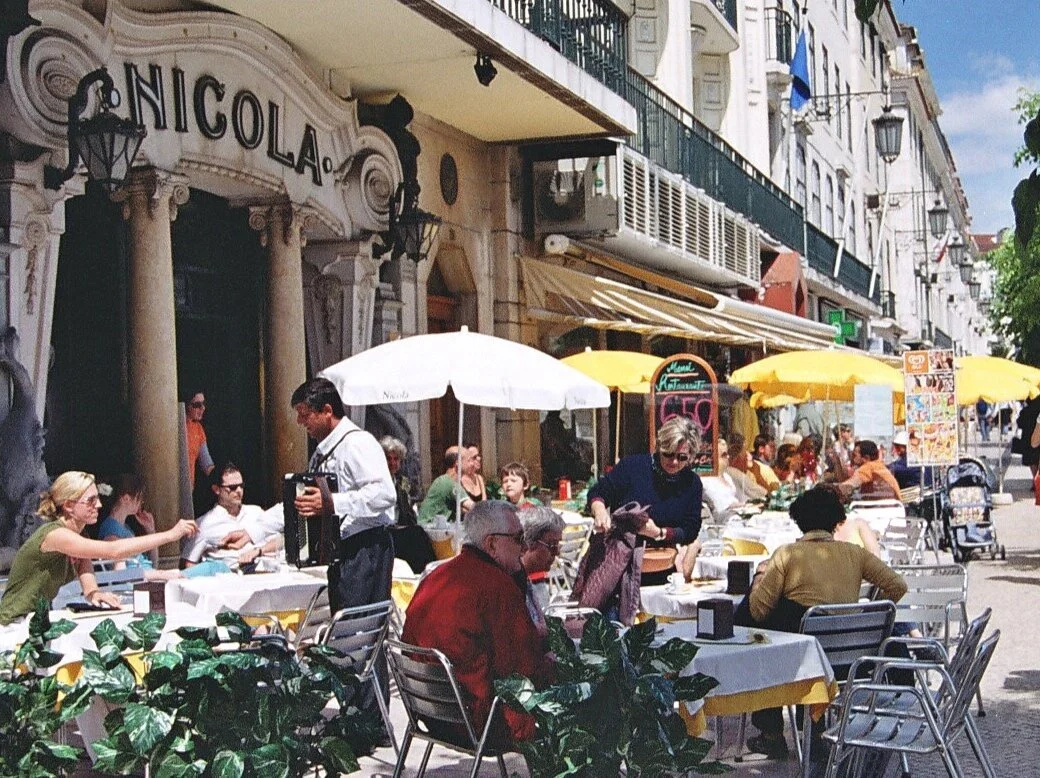
Lisbon loves its outdoor café life as much as Paris.

Lisbon’s hand-tiled streets gleam like gold in the night
Every plaza, street, alleyway, lane and sidewalk is a different mosaic of waves, stars, flowers, birds, sailing ships, anchors, mermaids, helix, zigzags and spirals. Heaven only knows how many miles we'd have to walk to see them all.
Even the pigeons show respect, and this morning we enjoyed a street sweeper singing and whistling as his broom caressed the old tiles. Yet here we seem to be the only pedestrians looking down. The voluptuous dinner of Portuguese oysters will later fulfill its erotic power, but what's making me ecstatic now is the tingle in my feet. I'm gliding over a city, like a figure skater on ice
“Let's walk all night till we drop, “I'd move to Lisbon just to walk here,” I say.
Lisbon reminds me of the earthy un-renovated charm of the older Europe I saw the summer of 1968 while living in London to interview West End theatre critics. There's laundry hanging everywhere and store mannequins wear sun-faded dresses that look retro but actually are that old. This is not to say that Portugal’s capital and largest city isn’t also thriving and hi-tech, and its Lisboetas very hip, with their boutique hotels, fab restaurants like Bica do Sapato (co-owned by John Malkovich) and megaclubs like Lux on the Santa Spolonia docks. But Mo Leanna and I prefer the old stuff—the tall narrow 16th-17th century dwellings with balconies and verandas, simple restaurants with oil cloth covered tables and rickety wooden chairs. And a busker’s haunting cello concert mingling with birdsong in an old tiled courtyard
This afternoon we felt like kids again on an old-fashioned cable car clanging through serpentine lanes too harrowing for cars. This afternoon we saw pensioners shopping for groceries, on foot, and a parade of tuba-playing, blonde-wigged riders lead by a wooden effigy of St. George nearly falling off its grand white horse. In restaurant windows we gaped at menus featuring “Squid on Roofing Tile” and “Camel's Drool” dessert.
The Cidade das Sete Colinas on the River Tagus has enthralled us with its hilly ocean views, fabulously ornate architecture, Moorish tiled facades and the unrenovated charm of the Europe I knew in 1968.
The Castlelo de São Jorge offers a gobsmacking panorama of the old city and its red panteel roofs. Although most of its surviving walls date from the Moorish period from 711 A.D., the Phoenicians had a fortress way up here around 1200 B.C., defending the settlement they called Alis Ubbo, Serene Harbour.
Then came the Greeks, the Carthaginians and the Romans, who called the town Olissipo. After the Visigoths came the Moors, who held Lissabona or Lishbona, until the Portuguese took over in 1147.
Surrounding the castle is the 8th-century Moorish warren of alleys and colourfully tiled houses known as the Alfama, from Al-hamma, meaning baths. Built on steep bedrock, it was spared the earthquake that destroyed two-thirds of Lisbon and killed 40,000 Lisboetas on All Saint's Day in 1755. ➤→➤→➤


“WALKING ON PEARLS: The story of Lisbon’s HAND TILED STREETS
Lisboa das Calcadas (Pavements of Lisbon), a small book by Ernesto Matos published in 2004 by Câmara Municipal de Lisboa, is so weirdly translated that it’s almost easier to read it in the Portuguese—even if you don’t read Portuguese. But it’s perhaps the only accessible book on Lisbon’s tiled streets, and its archival and contemporary photos are unique tributes to this mosaic city.
Fifteenth century Lisboa was a filthy place, with garbage overflowing the narrow tortuous streets stinking of excrement and plague. As Portugal entered its golden age of exploration, expanding its empire to Africa and South America and beyond, Lisbon needed a new image.
King D. João II conceived of “Rua Novas” – clean new streets for Lisbon fashioned from stone. He passed laws forcing inhabitants to clean the spaces in front of their houses and to contribute financially to the city’s paving.
In 1485 the first vessel transporting basalt quarried from the north arrived in Lisbon for the work to begin. The paving continued under the reign of King D. Manuel I and the great “Rua Nova d’el Rei” was completed on August 20, 1498, upon Vasco da Gama’s return from his voyage to India. Vessels loaded with heavy black basalt kept arriving from the Azores, Madeira and Viana and the ambitious paving project spread to other plazas, squares, streets and lanes.
Portugal’s Romantic Period took Lisbon’s paving to an artistic level with the transformation of Rossio Square, a hippodrome in the Roman Era, into a magnificent stone hymn to Portugal’s sea exploits. You feel you’re navigating rather than walking across it.
Following the design of Eusébio Furtado, Rossio’s paving began in 1848 and took 323 days. The hard labor of laying its 8,712 square meters with hand-hewn tiles shaped into ocean waves was done by prisoners trained by the town council’s master masons.
Every day the sunburnt prisoners, their heavy ankle chains clanging against the basalt, were dragged down from the Castle for a long day’s work. It was only the beginning: the Largo de Camões was completed in 1867, the Principe Real in 1870, Chiado Square in 1894, and by 1920 Lisbon had 400 skilled pavers.
The precious original wooden stencils used for the paving designs are stored in the Lisbon Council’s vaults, carefully protected to repair any broken tiles. Since 1950 Lisbon artists have contributed designs to new multi-colored pavings around the city. Hence, the vaults contain new stencils made from durable iron and PVC. (See if you can find the blue-tiled butterfly with yellow spots on its wings!) A walk around Lisbon is a luxurious walk over enduring works of art! ”
How to describe these murky alleys lit like painted theatre sets and the peeling façades and the ghostly laundry?
At 11pm the night is yet young. Before we know it, we're sitting at a candlelit oaken table with a gigantic carafe of cover charge wine, and Esmeralda Amoedo, the buxom, bangle-earringed, blue-lidded fadista in the black shawl begins her show.
As players of flutes, bagpipes, accordions and wild harps, we are excited by the Portuguese guitar technique, the sinuous melodies and earthy vocals of Fado.
“Mentira, mentirrra, mentiRRRRRRRRa. ” cries Esmeraldo, with breast-beating drama and trillllllled R's that sound especially accusing...
“She's singing about a liar,” I announce, summoning my Spanish and French. “Liars and cheats.”
In the wee hours, winding our woozy way through the Bairro Alto's carnival of flapping laundry and intoxicated revelers and fondling lovers, we come upon a shattered shop window. It's as if it were smashed for beauty's sake, rather than to steal anything inside this empty-looking café. The break is a spidery web shooting brilliant turquoise light in all directions.
“The glass is more intriguing when it's broken isn't it?” whispers Moh Leanna.
Like saudade, I have to admit that it is. ⎈⎈⎈⎈⎈

