
Take the A Train—to Harlem!
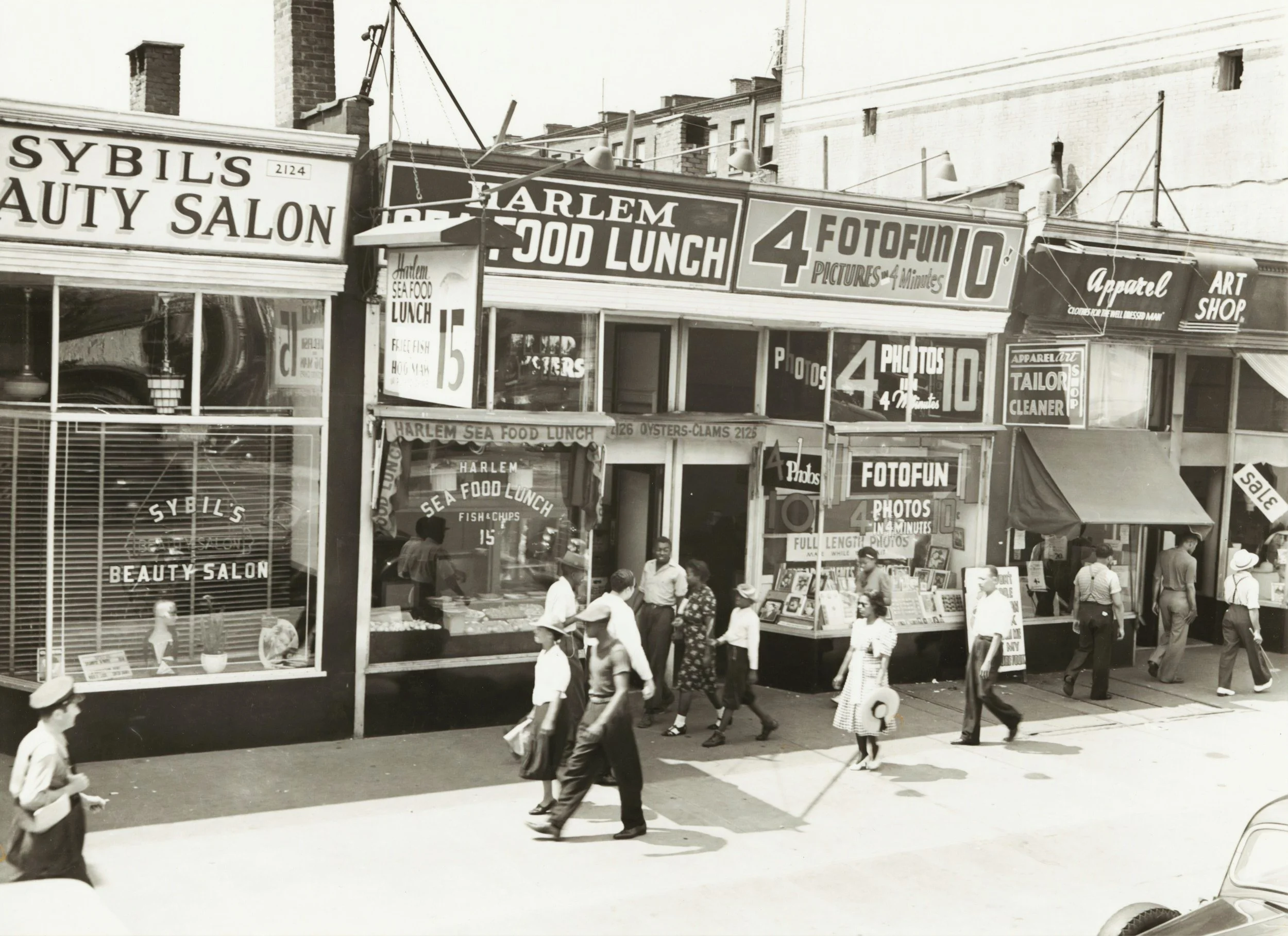
North American tourists to New York rarely venture up to Harlem, fearing it to be a black hole of drugs and muggers, whereas Europeans explore it in droves. After 20 years of living in and hanging around New York, it took the coaxing of a friend to get me to the Apollo. But after a night at the historic 1,447-seat theatre, and chatting with friendly street peddlars and mural artists, I was smitten by a fascination with Harlem, and made five more visits in the following two weeks. Take the New York City subway’s A train to get there. The long ride is an adventure in itself, as is a night at the Apollo Theatre.
When the boo level gets loud enough and the screamers in the cheap seats start hissing and poundinq the railings, the siren goes off and a clown in a white frizzy wig rushes out and drags you off the stage. And it's not funny. Not if you're a black kid who's taken the Greyhound from Selma, Alabama and spent your last greenback on new duds, just to test your rap routine on the Apollo Theatre's Amateur Night crowd. And not if you're a young miss from Mississip who breaks her piggy bank to buy a taffeta dress covered with bows to sing Summertime. You only get one chance. One dance. One song. One joke. And it's either please the applause meter or get laughed out of Harlem.
Tonight like every Wednesday night, there's an eager crowd milling around the old Apollo foyer for the four-hour long talent show where greats have been discovered since 1935. The chandeliers gleam down on photos of James Brown, The Jackson Five (Michael wowed them here as a 9 year old), Billie Holiday, Sarah Vaughan, Gladys Knight & the Pips, the Ink Spots, the Isley Brothers, the Shirelles and other superstars.
The Apollo's audience is renowned as one of the the toughest and most unforgiving in the world—scaring Sammy Davis Jr. mute even after he became a star, and spooking Flla Fitzgerald into singing. She came to Amateur Night prepared to dance but sang instead when her knees started knocking. Five bucks buys a high-altitude seat in the balcony. At one of the red-carpeted landings you laugh at the old sign "men must remove hats," until a tall dude sporting a beehive takes the seat in front of you.
Megawatts of energy
The band trumpets the rising of the shimmering pink curtain. The MC heralds the entrances of “Our next Future Stars” and a troop of breakdancers flash yellow satin across the stage. In a blur of panther leaps and lunges they send megawats of energy through the excited crowd. Then it's a seven-man group--drums, flute, sax, trumpet, electric guitars, keyboards, white felt hats and white sunglasses. Hoots and howls from below. Grunting and jiving in the balcony. Teenage girls scream when the crooner sweeps his hand over his...
The talent is amazing, and so is this carnival crowd of catcallers. It rivals a night at the Coliseum with gladiators and lions. Gospel singers, reggae and rap artists, stand-up comics come and go. Then a lone jokester cracks a flat one-liner that falls on deaf ears. And a kid named Ralphie gets booed back to Birmingham with his jazzercise act. A shy-looking plump teenage girl comes on. She politely takes the mike, and then people turn to butter and drip down the seats as she sings Somewhere Over the Rainbow like Judy Garland never could. The crowd goes wild. A winner is born.
North American tourists to New York rarely venture up to Harlem, fearing it to be a black hole of drugs and muggers, whereas Europeans explore it in droves. After twenty years of living in and hanging around New York, it took the coaxing of a friend to get me to the Apollo. But after a night at the historic 1,447-seat theatre, and chatting with friendly street peddlars and mural artists, I was smitten by a fascination with Harlem, and made five more visits in the following two weeks.
I loved my solo explorations of 125th Street, Harlem's main drag, and browsing for Black American and African crafts. I enjoyed strolling past the ornately decorated old brownstones on Convent Avenue and visiting local museums of Black American, Native American, Hispanic history and culture. I loved bringing Montreal friends uptown for some funky soul food, but I also enjoyed the Gospel and Jazz tours offered by Harlem Spirituals. It's the best way to experience Harlem's history and culture.
"Harlem is not the most dangerous neighborhood in NY," announces Muriel Samana into the bus microphone. "The most dangerous neighborhoods are the South Bronx, Brownsville, and East New York and Brooklyn. Looking out the window I'm collecting signs: Wishy Washy Laundromat, Dixie Drifter Variety & Grocery, Nubian Gro-Deli, Chewy's Cafe, Cutting the Crew (barber shop), Fried Colony Chicken and Trumbo's Funeral Chapel. Through the rain I see a sad parody of "the woman at the well—a woman filling half-gallon plastic Coke bottles from a spurting fire hydrant. Either she doesn't have running water where she lives, or she doesn't have any place to live.
Parisian elegance
Arriving at the the grand entrance to Harlem, I was startled by the Parisian elegance of Powell Boulevard. This eight-lane, tree-lined thoroughfare is wider than Park Ave. and has a version of the Arc de Triomphe at its head. Muriel explained that for two centuries after Peter Stuyvesant established the village of Nieuw Haarlem in 1658, it was the summer retreat of wealthy New Yorkers. Country estates with names like Quiet Vale and Happy Valley dotted the area, and area residents rode the ten miles down to New Amsterdam (now lower Manhattan) on a road built by the black slaves of the Dutch West India Company on an Indian trail, which is now part of Broadway.
From 1880-1910 Harlem was the chic area of New York, boasting its own Opera House, Yacht Club, Polo Grounds, and Philharmonic Orchestra. Between 1910 to 1920 Harlem turned from white to black, and during the roaring 20's it was the mecca of gaiety and excess—bootleg liquor and red-eye nights at the Cotton Club with Count Basie and Duke Ellington.
Our bus takes us through a Harlem rarely seen on TV—sedate, gracious old brownstones on quiet tree-lined streets of Striver's Row and Sugar Hill. Past the residence of Duke Ellington between 1939-61, the Ansonia House where Caruso, Mahler, and Toscanini lived, and the Teresa Hotel where Joe Louis celebrated his victories, and the former 1884 mansion of James A. Bailey of Barnum & Bailey Circus fame.
Set on a promontory overlooking the Harlem and Hudson Rivers and the Harlem Valley, on the summit of Sugar Hill, the Morris Jumel Mansion is the only pre-revolutionary house in Manhattan. This Georgian summer residence with an octagonal drawing room was built in 1765 for Colonel Roger Morris, and it served as George Washington's headquarters during the Battle of Harlem Heights in 1776. Later it became a roadside tavern until 1810.
We stop at Hamilton Grange, the 1882 two-story white frame house that was once Alexander Hamilton's summer home, at 142nd Street and Convent Avenue. Hamilton's statue stands sentry at the front, and a circle of 13 trees represents America's 13 colonies graces the yard. This tour doesn't allow time to explore the Mansion or the Grange, but they are open to the public. Our 14-bus polyglot tourist caravan pulls up to a stop outside the Mount Nebo Baptist Church, known for its gospel choirs. And here's where another Harlem begins...
Jacob’s Ladder sung full throttle
We're quietly led to the balcony and slide into pews beside curious stacks of antique trunks. Below us a blue-and-white robed choir of sizeable female singers stand beside a full drum kit. After a prayer and a few public announcements, the gospel singers open their throttles. The sonic boom is enough to crack stained glass. Big-mama voices singing Jacob's Ladder to the heavens without a microphone. You want to cry or swoon or roll on the floor. The service lasts for four hours, and with the thundering organ, swaying choir, ecstatic clapping congregation, sometimes people do fall into a trance. But before we can lose consciousness, little women wearing white dresses, white gloves and veiled pillbox hats come around with big silver offering plates.
On another night on a Harlem Spiritual's soul food and jazz tour, I was sitting at a banquet table piled with collard greens, barbecued spareribs, fried chicken, potato salad, green beans, pickled beets, and black-eyed peas. Ice tea seemed like the drink to go with all that southern grub, but Sylvia's Long Island ice tea is not the Bible-Belt version my grandmother used to make. Sylvia's potion contains rum, gin, vodka, tequila, triple sec, coke and lemon juice—and not a drop of "tea."
Across from me sat a couple from Cannes, at my right, tourists from Stuttgart, at my left, a couple from Valencia. What do you do when out of the corner of your eye, you see a plate piled with soul food flip into the air and fall into a lap? When you watch as chicken legs collide with collard greens and candied yams and lumps of potato salad in mid-air, then disappear? And you know that nobody else has seen it but you?
I squirmed not to laugh at the dignified man sitting across from me, or to notice his empty dirty plate. But when his wife started snickering, then giggling, then guffawing, I heartily joined in. Par hazard, our French-speaking tour guide took this moment to pass by. "Est-ce que tout va bien ici?" she asked.
Before dinner our tour bus had stopped at a crafts mart and I blew $40 on a wild zebra-striped hat with a pointy top, made from "mudcloth" dyed with tree bark from Mali. I'd never have the nerve to wear it outside of Harlem, but seeing all the tribal jewelry, headscaves, herbal potions and voodoo dolls in the crafts bazaar made you think you were in Africa and some of us came out looking like Zulu chiefs.
We spent the rest of the evening tapping to jazz at the Showman's Cafe Jazz Club, with Jesse Hameen II on drums, Joe Johnson on organ, and Randy Johnston on guitar. Irene Reid poured her heart into a medly of oldies like "Alexander's Ragtime Band," "Fever in the Morning," "Sonny," "Lost in a Masquerade" and belted out some gospels.
The last leg of my Harlem adventure took me into the Trinity Cemetary (Riverside Drive to Amsterdam Avenue 153-155th Sts), once the farm of ornithologist/artist John James Audubon, and to the wonderful old museums around Audubon Terrace (Broadway and 155th St.)
The Hispanic Society of America has been described as l'darkly magnificent, cool and hushed as the interior of a Spanish grandee's castle," and I would agree. The priceless collection of archives and objects on Spain, Portugal and colonial Hispanic America include 12,000 books printed before 1701, and archaeological treasures which Archer Milton Huntington brought back from the Iberian Peninsula in 1892. It's all pretty fabulous.
The National Museum of the American Indian is the largest museum of its kind in the world and a part of the Smithsonian Institution. Its collection are vast and activities range from demonstrations of Cherokee Quillwork, rawhide painting, and Mayan weaving to Bolivian and Andean music. and don't miss seeing the bizarre and unbelieveable shrunken human figures from the head-hunting Jivaro Indians of Ecuador.
Harlem's other museums include: The Schomberg Center for Research in Black Culture (515 Lenox Ave, 491-2200) is where Alex Haley did his research for Roots. The Studio Museum in Harlem (144 West 125th St.) is a major cultural center for the black artists and performers, hosting exhibitions, concerts, films and lectures.

IF YOU GO...
The boundaries of Harlem extend from 110th Street to 165th Street, and from the Harlem River on the East to the Hudson River on the west. It's a straight run on the 8th Avenue A or E trains to 125th Street and the Apollo Theatre and Mart 125. Map your itinerary before you go, pinpointing the sites you want to see.
Sylvia's (328 Lenox Avenue, 996-0660) —”The Queen of Soul Food” is the Sardi's of Black New York, a popular hang-out for celebrities, and lovers of Soul Food like catfish fingers and chicken livers, and of course corn bread and barbecued ribs and fried, fried fried chicken! But I had more fun (overturned dinner plates aside) eating at the small divey, TV-on-the-wall Jamaican American Hot Pot. The Hot Pot menu featured Hot, Hot Spicy Jerk Chicken, Chicken and Waffles, Curried goat, Oxtails, Cow Foot, Escovietch (pan-fried fish simmer in Jamaican herbs and spices) and seafood creole. The cornbread muffins were mmmmmmmm-good, and the side dishes included rice and peas, collard greens, cabbage, fried plantains, callaloo, Jamaican ackee—a "yellow tree vegetable in a red pod—looks like scrambled eggs," said the waitress. And for sweets--bread pudding, sweet potato pie, and peach cobbler!
The Apollo Theatre, 253 West 125th Street, opened in 1913 as a burlesque house and in 1934 became a vaudeville theatre. Every Wednesday night is Amateur Night from 7:30 p.m. on. The rest of the week, it's big-name concerts. There’s nothing now in Harlem like the old Cotton Club , but you might take a look at these suggestions.