
Inishbofin - Ireland’s Island of the White Cow

A donkey with creels of turf overlooking Inishbofin Harbor
When tourism seems to be the island's only future, will I one day return to find Bofin's heather hills scarred with glass, its old ones in the boneyard and their hearths on loan to city seekers of the quaint life?
“How I came to write about Inishbofin...
I was back in New York City, in between my jaunts back & forth to Ireland. I was in the Bells of Hells Irish pub and ran into writer Jack Deacy who I knew from my New York Magazine days. I told Jack about my latest adventures, hitchhiking around Ireland with my mother and my crazy jaunt out to the island of Inishbofin. He urged me to query his friend Ken Labiche a new editor at GEO magazine.
Months passed and I made my way over to Paris to join my mother Peig for our grand busking tour of Europe. One thing I’d dragged over to Europe was my portable Olivetti typewriter. While Peig and I were “based” at the humble Hotel de Paris, I wrote a long rambling proposal to GEO with my thoughts on Inishbofin. I only had cheap crummy paper, and little did I imagine, that was also what helped to impress Ken Labiche, that I was a real writer, living on the edge.
My proposal was a ridiculously long seven pages. I got an answer back nine weeks later, saying the magazine wanted me to go to Inishbofin, and they would pay me $3000 US for the article, and $3000 for expenses. I would not have to spend my advance on trans-Atlantic airfares, because I was already across the pond. I could spend more time on the island—not just two weeks. I was over the moon with excitement.
At the end of our busking adventure, Peig went back to Poughkeepsie, and I went back to Dublin, where I loaded up with supplies from Dublin, and Galway, and lugged it all on the bus and boat back to Bofin!”
The Furies
of Inishbofin

Burning everything from old Wellie boots to butter wrappers to keep warm
I love being here, but last night I went berserk. After ten shuddering hours of trying to light a fire in this dark howling cottage—after stacking the clumsy damp sods of turf and throwing on parrafin fire lighters and butter wrappers and scraps of old Wellingtons and plastic bottles belched by the sea onto the strand outside my door; after huffing and blowing and choking on ashes and singing my hair, and the hail whistling and cracking the windows and the wind strangling the candles, and after all and all, and only two beady coals leering out of a steaming black cave—I went berserk.
I took the tongs and beat the sods and shrieked and beat and screamed and crushed the glowing lumps until they spattered over the stone floor in a lurid wet mash. My blood felt like murder and I didn't care if I set the house and my own self on fire, only to have light and heat. Cold, scared, raging and helpless, I met the Furies of Inishbofin.

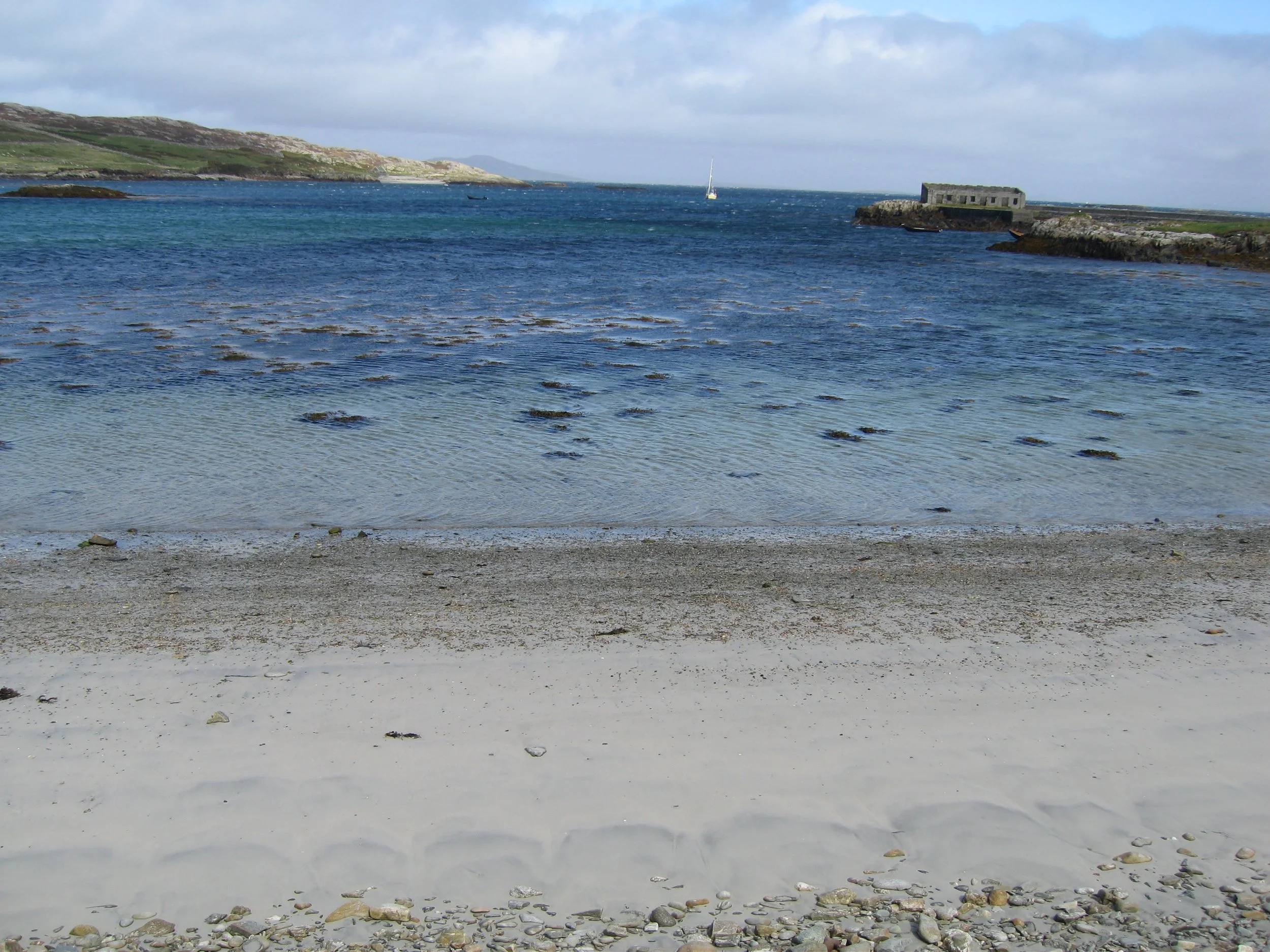
Old fish curing shed on Inishbofin

Inishbofin Harbour

Will the boat go, or will she not? On Inishbofin it takes binoculars to find out.

Cairn atop Middle Quarter, Inishbofin

Inishbofin Highway
This is what my love of Irish music has led me to: a sea-torn island with no electricity, minimal plumbing and a tiny potholed road not fit for donkeys. Inishbofin, County Galway: a speck in the Atlantic six miles out to sea from the village of Cleggan on the bald rocky coast of Connemara; a crusty weathered hunk of land five miles long and three miles wide, population 200 and dwindling.
Strangely, this largest island of a tiny archipelago consisting of Inishshark, Davilaun and Inishlyon is the only one of Eire’s 300 odd islands that appears on a 1912 map drawn up by Thomas Johnson Westropp titled, The Legendary and Sunken Islands of Ireland. These enchanted lands were said to have rivers of fire, wine and milk, sea strands made of dragon stones and crystals, magic fountains and wondrous psalm-singing birds. They had been doomed to drift eternally after the vengeful sea god Mannanan MacLir ordered the waves to cut their roots and whelm them beyond the gray and endless deep. But they rose up from the sea god’s realm every seven years, to be sighted by a rare few and sink again beneath the waves.
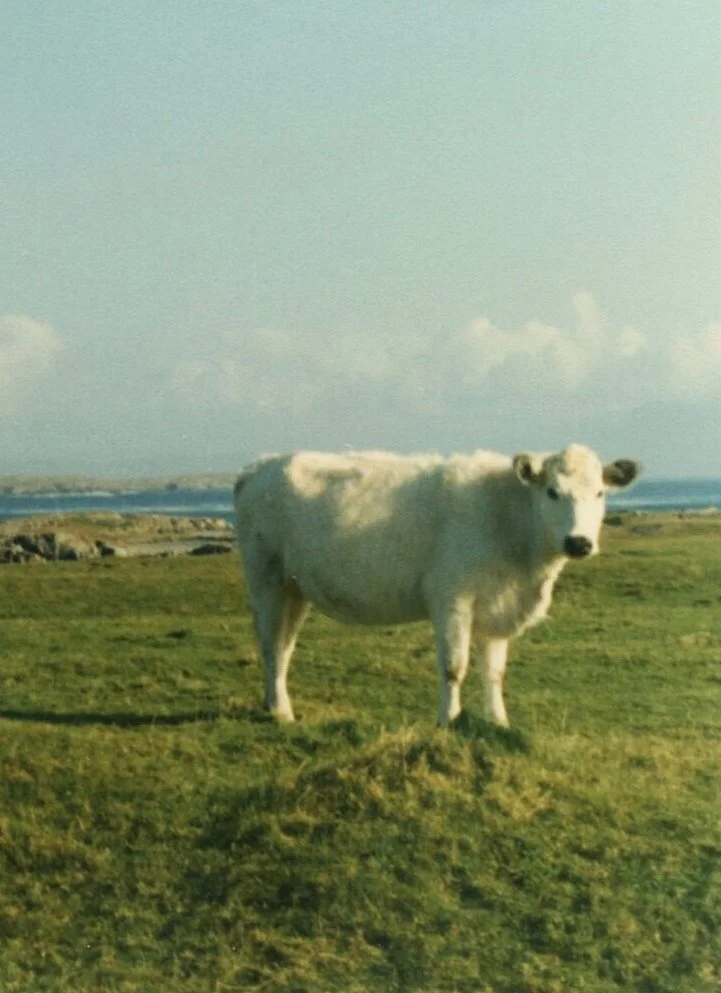
A white cow on Inish bó finne, Island of the White Cow.
Storytelling is “dead out”
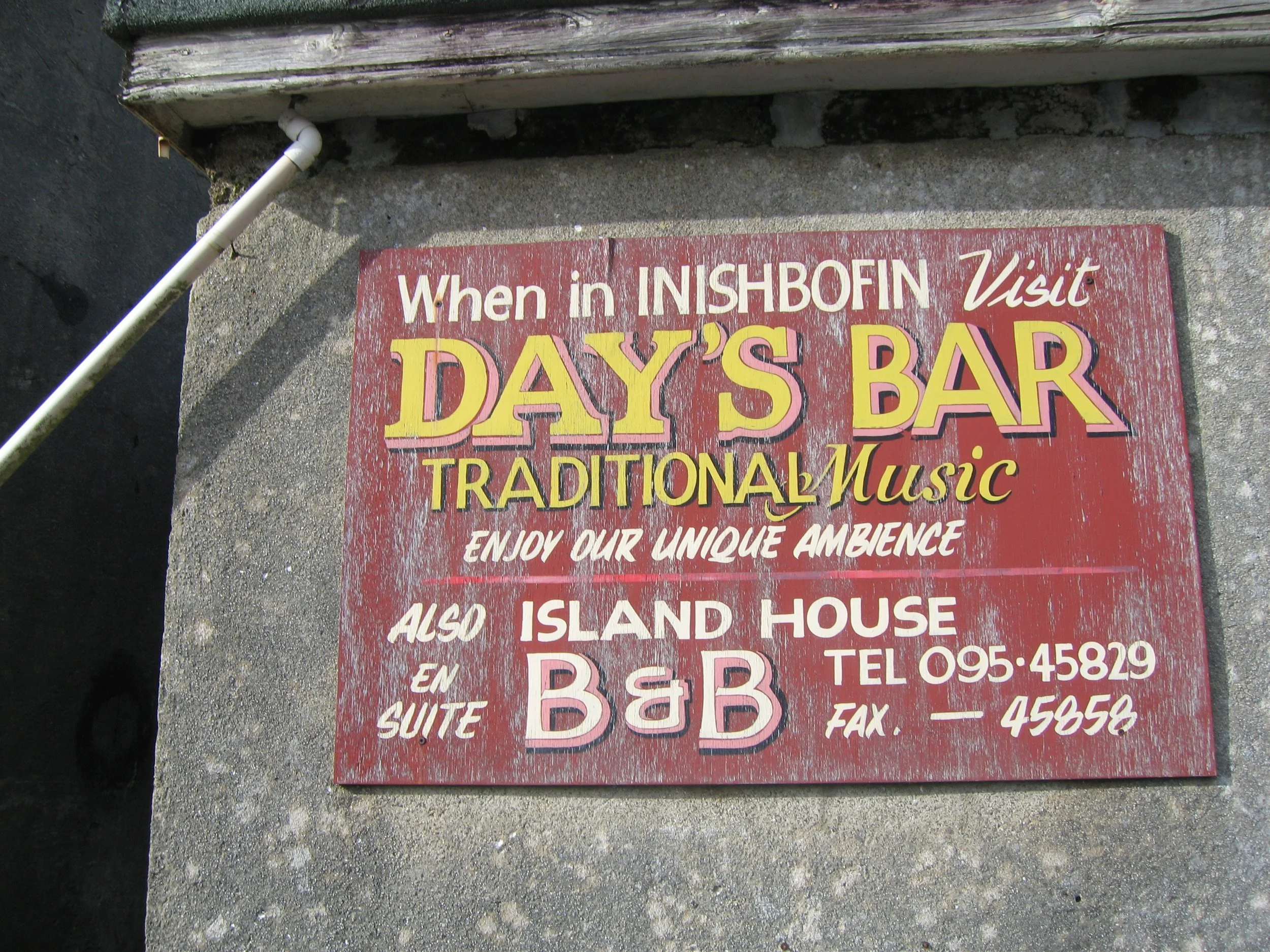
Bofin people don't like to talk about magic anymore. No, the only myth talked about on the island these days is the old White Cow legend printed on wooden plaques and sold in the lobby of Day's Hotel. Storytelling, other than gossip, is ‘dead out.’ It died along with the house ceili dances when the spark of social life flew out of the cottage hearth and into the pub. It died when Irish pound notes replaced kettles of fish and drops of parrafin oil as means of island barter.
A few island place names like Gap na Síog (The Fairy Gap) and Aill a’ Phuca (Cliff of the Fairies) belie the old superstitions. But you mention fairies and banshees today and they scoff and snicker. Yet when walking back to Rusheen along the low road on a moonless night, they’ll turn at the crossroads by the old derelict two-story house to take the windy high road, even though it weaves a longer path and will tumble you about. The low road is sheltered and more direct. But it passes within spooking distance of the ancestral graveyard.
Island of the White Cow
Bofin islanders say that Inishbofin's enchantment was broken one night when two fishermen lost in a swirling fog landed upon its shores. The fishermen lit a fire and the island stood fixed, and through the rising mists they saw a red-haired shrivelled hag driving a milk-white heifer into a lake. They caught the cow by the tail, but the tail turned into a root, and the hag and the cow vanished under the lake. Seven years hence, and for every seven years after that, the cow was seen to rise up out of Loch Bó Finne and wander about the island. And so the island was named Inish bó finne, Island of the White Cow.
Summer visitors swear that Inishbofin is still enchanted. The very rare and lucky white heather grows on the island’s wild northern slopes, and magic mushrooms sprout up queerly through flaps of cow dung. Not the towering variety that shelter fairies and elves, but the hallucinogenic psilocybin. Those with psychedelic appetites have been known to see white cows after eating platefuls of them.

Don Bosco’s Castle on Inishbofin - in the fog, in a “calm” sea
Bofin’s cursed with magic
I was first tempted to go to Inishbofin one sodden afternoon at The Brazen Head an old Dublin pub banging with fiddles and banjos. Paul MacDonald, a guitar-playing friend on his fifth pint of Guinness was rhapsodizing about the terrible beauties of the West of Ireland. I told him about meeting the writer Sydney Smith the week before, and how he’d raved about this place called Inishbofin, where he’d lived and written plays and pageants for the islanders to perform. But the island was primitive, he said with a twinkling grimace, recalling the morning he’d dumped the contents of his ‘chemical toilet’ into the sea, only to have a wave lash it back all over him!
“Bofin’s cursed with magic!” Paul laughed, twanging the top E on his guitar. “Once you get out there you'll lose your head, wish the fog would come down so you'll never have to leave. The islanders still ride donkeys to the bog and to ‘town’—a pub and a phone box. And everybody on the island’s related to everybody else—third cousin or half-sister or great uncle, or whatever-you-like half-removed—so island life is communal. And there are no gardaí to police the island so the pubs never have to close,” he said, licking the foam on his Guinness.

On the Lenane Head from Cleggan to to Inishbofin Harbour
I said I’d been surprised to hear of other Irish islands besides the Arans.
“My God, yes!” Paul jumped. “There's Inishshark, and Cape Clare and Tory and Inishturk, Sherkin, and Valentia and about 300 other odd bits of land. But you and lots of other people haven't heard of ‘em because they aren’t tourist traps like the Arans. I know people in County Galway who've never even heard of Bofin, or they think it's somewhere in the Hebrides. The Aran Islanders speak Gaelic,” Paul continued. “Because they’ve got the sacred native tongue, they’ve gotten government subsidies for electricity and tarmac roads and crafts shops and horse-drawn sidecars to haul the tourists around, and a secondary school so the kids don't have to emigrate at age 12 to get higher education on the mainland.”
“Because of all the tourists, The Arans have big ferry boats that can cross in gales, and airstrips to fly you in and out as you please sir, and a pub the call the American Bar. Bofin was settled by English monks and Cromwell's soldiers. The last Gaelic speaker on Bofin died over a hundred years ago, and so the island is an unwanted orphan of the Irish Government. Bofin's got no electricity, except for the generator at Day’s Hotel, and the shops haven't got much beside tinned peas, candles, bananas and stale Easter eggs” Paul went on. “The little post boat won't cross to the mainland in a rough sea, and the sea could be rough any day of the year. If you go in, there's no telling when you'll come back out."
Boat to Bofin

Supplies unloaded at the Inishbofin Harbour
On a balmy morning in late May, I hitchhiked from Dublin to Galway and then out to Cleggan, a scattered harbor village with a few houses, a shop, a pub and a crowd of peeling boats. A fire crackled over the mumbling voices in the Pier Bar, and I fell into chat with the people waiting for the post boat to Bofin: a veterinarian going over to test the cattle for brucellosis, an Electricity Supply Board agent going over to peddle electricity, a country doctor making his weekly call, the island priest who looked too young for the part, and a salty islander who'd seen the world in trawlers.
The harbormaster and his oilskin-clad crew waited at the side of the Leenane Head with the cargo: cases of sliced white bread, bulging sacks of coal, barrels of Guinness, a limp mailbag, a roll of flowered wallpaper and a ton of cinder blocks. After an hour of heaving and hauling the cinder blocks, we pulled anchor on the creaking craft and set off for our six-mile slurp across the sea, with only the priest’s Hail-Marys to save our lives lest we sink.
Gray sky and gray waves closed in around us. We rolled and slapped for an hour, when suddenly a hunk of land rose up like a scaly dragon and then vanished in a thick green mist. We glided along until looming darkly on the cliff over our heads was a jagged shape of rocks and broken towers with windows like the hollow eye sockets of a skull. “Don Bosco's castle,” shouted the old seaman. “The Spanish pirate in cahoots with Gráine Uaile, the feisty lady pirate who terrorized these coasts from Kerry to Donegal in the 16th century.”
The boat steered around the tip of a boulder that jutted out like a shark’s fin. “That’s Bishop's Rock,” the seaman roared. “In the old Irish penal times, Bofin served as a prison for Catholic priests. On this very rock Cromwell's soldiers chained a bishop at low tide, and stood watch as the rising tide crept down his throat to drown him.” The boat’s prow circled a tiny islet strewn with the stony carapace of a fish curing house, skeletal remains from the days of the big island fisheries when a hundred 100-ton ships would harbor here. And then out of the mist broke the pale green sweep of Inishbofin—mountainy, voluptuous, stark and frightening.
A road fit for a donkey
I climbed out of the boat and trundled up a hill and found a road such as I’d never seen: four feet wide, with dips and pits and ruts and bumps, squeezed between the blackberry hedge and the stone wall—fine for a donkey but ridiculous for wheeled conveyances. I set out to look for a camping spot with a spectacular view.

Geese on Inishbofin
I passed hay mounds and potato ridges and a long-faced Morris Minor with four flat tires; stacks of turf set out to dry under sheered clouds of blue-stained fleece; idle donkeys, new caravans and rubbled cottages with gouged windows, a lake with drifting swans, the ruins of a 14th century stone chapel and the lone stone bullaun left from the plundered seventh-century monastery built by the island's first known inhabitants The sea followed me everywhere— rising, tilting, stretching beyond bogs and cliffs and the rock-scabbed hills.
By and by I passed a little man in a big-shouldered wool coat tied with a string. He offered me a camping plot near his cabbage patch for the night, but I declined. I thanked him and kept on walking, past piles of handmade lobster pots, a bramble-tangled graveyard and more donkeys, until I saw a pale stretch of sand and a lone curragh lying overturned like a skinned mackerel, with its black tarred canvas rotting away from its wooden ribs.
Here I camped, on a goose-feathered field overlooking the Atlantic and across from an islet which the Irish Ordnance Survey Map called Inis Laighean— Inishlyon. I passed a calm night dizzy with stars and roving satellites and awakened giddily to bright warming sand dunes. The next afternoon a fierce wind blew up. I took a long roaring walk against it down to the pub, which looked like ski lodge with high-sloping walls.

Camping on Bofin - ready to be blown away!
I sat myself down next to the only other female there, a squat matronly woman in her fifties whose weathered face, windblown hair and worried eyes were hardly in keeping with her stockings and polished high heels. Lena remarked about the weather and the fact that I was here too early to appreciate the island in its full-blown summer madness.
“In July this island will be well and truly packed!” she cackled. “With campers and daytrippers and cottage renters. And my guest house’ll be stuffed with Germans and Dutch and French and Americans, and bird watchers and botanists and divers and painters and hikers and neurotic writers,” she fired breathlessly.
“For some queer reason I can’t figure, my dear, she said gravely, Bofin has a great attraction for neurotic writers. I had a guest once—a learned professor from that Trinity College in Dublin—who paced and muttered around his candle all night long, about his thee-sus. Woke me up at 4 a.m. in the dead of a wet morning with his rantings and grumblings and I demanded to know what he was about at that time of night! ‘Oh, it's nothing,’ he says to me. ‘I always write this way.’ ‘Well you can’t write that way here!’ I says to him. Go rave at the moon or the geese in the bog, or I’ll put you out tomorrow!’”
I couldn’t get a laugh in edgewise. Lena told me how the professor did leave the next day—without paying her the week's rent he owed. And he left behind a huge old tome on Joff-ree Chaw-ser, just the thing Lena wouldn't know what it in the world to do with.


Map of Inishbofin, showing Inishlyon
Off to Ballinasloe hospital in a straitjacket…
“And then we had a poet on the island,” Lena continued. “A Yank who got the writer's block so bad he filled a bottle with sand and hurled it at some men digging a grave. Ye can see a bronze plaque with some of his poetry on it over there. Theo-dore Roeth-ke. Won that Pew-litt-ser Prize. Came here in the summer of 1960, and was writin’ about how the Bofin landscape reflects a state of mind. I guess he went mental doin’ it. They carried him off to the Ballinasloe hospital in a straitjacket.”
“And now we’ve got a psycho lady in from Paris. I call her The Screamer because she tromps for six hours a day and screams over the cliffs whenever she can’t sort out her bloody French sentences! A film critic from Paris, Luh Fig-a-roh, sealed away in a damp cottage to write an eggsus-ten-shull novel I suppose. But she’ll be gone after the first gale hits.” It hardly seemed the opportune moment to mention that I was a writer, so I told Lena about the great camping spot I'd found—across from the islet bearing my family name.
Lena downed her hot whiskey and slammed the empty glass on the counter. She grabbed me by the arm and pulled me out the pub before she could explain that she'd seen my tent that afternoon. With gales forecast for the night, she knew that if I stayed in it, I could be blown out to sea, or smacked against a stone wall and torn to shreds. She’d seen tents with people in them blown away before.
“Blown away ?” I gasped.
“Where do you think you are girl! Around here they still talk about the night of The Big Wind like it happened yesterday, even though it was the sixth of January, 1839. The sea went lunatic and hurled monster boulders against the cliffs. All the houses on Bofin were blown away but one. By dawn that house was filled with twenty baby cradles!”
Lena led me to the top of the little hill behind the pub where she’d parked her old Morris Minor. She started it with a can opener, and then we took off toward my campsite, bumping along the road in the dim purple twilight. By the time we reached the beach near Inishlyon, the wind was truly wild. We caught the billowing tent and flung it into the car and rode to her cottage in blackness with the wind heaving us over the tiny island road. When we arrived at her tidy place with a turf fire burning and a bare gaslight hanging over the kitchen table, I was in a daze. But I heard her say I could stay with her for the week and not pay her “a single shilling.”
A vicious and sublime piece of land
This is what my curiosity has lured me to—a vicious and sublime piece of land where 200 islanders live tenaciously and despite demoralizing odds; a community bewildered between the old life of work-sharing and storytelling and the new life of electricity and television. Where life teeters between the profound and the monotonous, the zany and the tragic.
In the long days at Lena's I heard island tales of pirates and smugglers and sunken Spanish Armada ships, and stories that impressed on me just how much the islanders’ precarious existence was at the mercy of nature. You might laugh about the islander whose false teeth were grabbed out of his mouth by a wave as he was picking winkles at high tide, but not about the fisherman castrated by a kicking horse one week after his wedding, or the woman still bearing the scars after being attacked as a little girl by a donkey in heat.
The old people remember all the stories, the capers and the strange changes they’ve lived through. The self-appointed island genealogist and historian, the octogenarian Michael Cunnane, known as Mick the Roux for his shock of flaming hair, was eager to tell me the whole history of the island in one gulp, one night at his lonely cottage. Since he was a gossun at his grandfather’s knee, he’d taken it upon himself to memorize the histories of the islanders for two hundred years back. By modern standards it was impressive, but compared to the recall of the ancient Celtic fili —the bardic poets—it was a mere scrap of time.
Insula Vitulae Albae
Like the best of the few remaining Irish storytellers, Mick could tell the history of Inishbofin as if he’d seen it all with his own eyes. I watched and listened as he sat there in trance-like concentration for four hours, with the candlelight flickering eerily on his face, and the wind howling outside his cottage door.
“The first documented inhabitants we had on this island were Irish and English monks,” he began. “They came here in 665 A.D. with Saint Colman, bishop of Lindisfarne and Northumbria. Them monks knew the island as Insula Vitulae Albae, or Island of the White Heifer,” said Mick, demonstrating his Latin. “Yer man Colman had a dispute with St. Columcille about settin’ the day for Easter Sunday to please Rome.
“Colman refused to abandon the old Celtic church practices, and left the island of Iona and came here with some dissenting Irish and English monks. They built a monastery, the ruins of which ye can see by the graveyard. Colman assigned the English monks to do the teachin’ and cookin’ and what have you, and sent the Irish monks out tillin’ the land. That went on for a while, until a dispute arose between the English and Irish monks about the division of labor. Then St. Colman packed th’English monks off to County Mayo and came back and spent most of his life on Bofin, till he died in 676 A.D.
“Up until the 10th century, the only population that was ever mentioned in historical records was the monastic settlement. There’s a big gap in the history of th’island until the 16th century, when it was taken over by pirates. The 26 ships of the Spanish Armada were wrecked off the Irish coast in the autumn of 1588, and the 300-ton pay ship, the Falco Blanco Mediano, with the admiral of the fleet Alonzo Bosco on board, broke up on the rocks near Davilaun Island. She’d be carryin’ gold bars and 16 guns, includin’ six copper cannons, which would be of good value today.”
“Did anyone ever dive to look for her?” I broke in.
“They did. Some divers came in here four years ago. They found the ship, but we don’t know what they got. The ship’s still there. And as well as havin’ the gold aboard, the Spanish had their war horses, Arab stallions. Some of them got clear of the ship and swam across to the mainland, where they mated with Shetland ponies running wild on Connemara. And that’s where we got the Connemara pony.
“Anyway.” Mick continued, “Don Bosco and some chaps named White and Corbett got ashore to Inishbofin and settled a while. Bosco took up the life of a buccaneer and allied with that fierce Pirate Queen Grace O’Malley—known as Gráine Uaile, whose clan of sea mercenaries captured Bofin in 1380. For years until her death in 1603, she and Don Bosco controlled the harbour with a chain boom strung across either end from Don Bosco’s castle to Scealp na gCat.

“The next crowd that came in here,” continued Mick, lighting another candle, “was Oliver Cromwell and his men, in 1653. They turned Bosco’s castle into a fort and Bofin became the place Catholic priests were sent to be executed. There’s a deep chasm in the rocks on the northeast side of this island called an prisiun—the prison. Cromwell’s soldiers would lay a plank across the cliffs over the chasm and force the priest to walk across the plank. When the priest got midway across, they’d flip the plank and watch him fall hundreds of feet and be shredded on the rocks.”
Shredded on the rocks! The island seemed so peaceful now. Yes the winds could be wild, but the scenes of priests chained to rocks to drown them or pushed onto skull-splitting rocks was unthinkable. Mick’s storytelling could have gone on all night, so eager was he to have an audience, even of one. “The young ones here now, they’re all telly boys and telly girls,” he muttered in a tired voice. “They only want to move to the cities. The life on Bofin is over.”
Win a tin of biscuits
The older islanders had grown up with dramas and crossroads dances and visiting and storytelling. But since the telly's debut, bringing greed from Dallas and speed from New York to the two hotels and few houses with electric generators, these amusements were “dead out.” Now there was only the Sunday night bingo emceed by the priest: Win a Tin of Biscuits. Or stay at home and watch a drama of embers and listen to the news on the wireless. There were still a few musicians on the island who knew the old dance tunes. But on an island of bachelors, why have a ceili when there were no single women to dance with? Emigration was the specter that shadowed the past and future of every islander. It had created a lopsided population of 65% pensioners, 27% bachelors, 7% school-children, and one young single woman. Until recently, unemployed single women in Ireland weren’t allowed to collect the dole, and so they abandoned their islands to find work and husbands on the mainland.
The only hope for Bofin's economic future, some people thought, was tourism. Not so repugnant an idea, perhaps, when the island’s spate of reasonable weather was at best eight weeks. But I thought of the brash, bronzed visiting Californian who’d accosted me on the little island road. He’d spoken to me in conspiratorial tones of his Grand Plans for the island. Geared up in a flashy red jacket and short-shorts that flaunted his thunder thighs, he’d hunched over his $2,000 custom built 100-speed pot-hole-proof bike, and squinted close to my face. He described his visions of lakes stocked with trout eggs—he’d single-handedly import fly-fishing to Inishbofin— and industrial washing machines. It was high time things got civilized here, he said, and he was just the one to do it.
Down at the pub I heard islanders referring to him as “Kojak” because he was the spitting image of the bald TV tough. He’d come to Inishbofin to buy some land, and the islanders were leading him on in the best of Irish tradition. Drawing out negotiations as long as they could, so that Kojak would have to make several visits and buy the islanders endless rounds of drinks. But all Kojak's scheming would come to naught. Any Bofin man who sold his land to this ranting industrialist would promptly be lynched by an island mob.
The more I saw and heard, the more Inishbofin fascinated me. Its people wore modern clothes but farmed with donkeys and fished in boats of the most ancient kind to be found in Europe—tar-covered curraghs descended from the sixth century rudderless skin boat of Saint Breandan the Navigator.
Here you could find economic gaps centuries apart: island houses with designer bathrooms with bidets, and houses whose toilet facilities were a shovel and a hole in the ground; a room lit with a 300-watt bulb and another with a tattered black mantle providing the wattage of a jam jar of fireflies; a woman who tossed her Switzer’s designer sheets into the washing machine, and a woman who scraped dirty diapers and boiled them in an iron pot over a turf fire.
And for recreation—one who traveled all the way to Dublin to go shopping, and another who stared at a fire and fumbled her rosary beads. In the days when the islanders all lived in mud huts and fished and farmed for a livelihood, the Have's drank tea and the Have-nots drank water. But now the class differences were worlds and centuries apart.
The haunting remoteness of the island, not so physically far from the Galway Races and the seaside amusements at Salthill and yet so far away in mentality, was compelling. But unlike some visitors, I didn't think that it would be a shame when Inishbofin got electricity. Not for the mother of nine who ironed with a heavy old iron kept on the hearth, or the school kids who suffered eyestrain from flickering gaslight and headaches from the parrafin oil fumes. Or for everyone who feared those occasional accidents, tipped candles, kerosene fires and exploding gas tanks. Yet I knew that the coming of electricity would break the island’s spell of magic.
Gone forever would be the dead stillness of its night, the shocking brightness of a full moon shining on a dark world, and the running joke on Bofin that the greatest offense you could ever have brought against you was “drunk in charge of a torch.” And so I decided to return in late summer, to live through Inishbofin’s last winter without electricity, to teach the island children the tin whistle, and to perhaps count myself among the island's eccentric scribes.

A harbor bobbing with yachts
In late August the island harbor was bobbing with yachts. The pier was littered with diving gear and a crowd decked out in flippers. Foreign accents percolated out of the pub, and the little road resounded with the crunch of bicycles. The bogs and cliffs were flashes of unruly color, and the lonely grassy field where I had camped before was like a regatta. Urbanites from everywhere had come to see Ireland of the Welcomes—happy old men with their caps and their cows.
Since May, electric poles had sprung up like Calvary crosses all over the island. Soon the Great Generator would come and banish the batteries and the wicks and mantles, and there would be hairdryers and clothes dryers and electric fires and more television sets. But when, no one knew exactly. The contracts weren't settled. The powerhouses weren't built. The houses weren't wired. And the dirty weather was soon coming on, making all these jobs impossible.
I disembarked from the Leenane Head and dumped my load of ‘tin whistles and birdseed’ as my Dublin friends had called my granola and grains, in the veranda of Day’s Hotel. My island provisions consisted of 45 pounds of brown rice, beans, popcorn and garbanzos, books, typewriter ribbons, reams of paper and blank notebooks, hot water bottles and batteries, long underwear and Wellingtons, a bicycle, an oil lamp and an accordion, a pile of sweaters and tin whistles, and a goatskin drum. But who knew what you would need for five months on an island with no electricity, no library and a shop with only tinned peas and Easter eggs?
I set out for a long walk to Horseshoe Bay. The flute player I'd met on the boat had invited me to supper. When I arrived at the old cottage where he was staying, it was filled with tourists from Normandy who had been island-hopping all week long from Achill Island, Clare Island and neighboring Inishturk. They'd sailed their yacht to Inishbofin upon hearing reports of a cozy harbor and friendly natives, and now sat sipping Bordeaux before a hearth steaming with wet bathing suits.
The chef made ready the table and the old gas lamp and spread before us an island-reaped feast I would dream about for months to come: a wreath of fat crab just pulled from the nets, tender island lamb, a garden of island vegetables, and for dessert, a delicate flan made of carrageen moss laced with Irish whiskey. The wild pink sky was streaked with pewter, the sea lapped sweetly around us, and the French were rhapsodic. “Quelle îsle magnifique! Et sans electricité, c'est si romantique! ”
After the feasting we floated down to the pub, which flowed over the rim and down the sides and out onto the pier with tourists and brawny fishermen from Inishturk, refugees from Dublin and Belfast, Electricity Supply Board lads working for the summer, and island children back home from London, Bermuda and the Bronx—and more tourists. Fiddles scraped and accordions wheezed and the floor shook till the tables danced. By 4 a.m. everyone had evaporated but the musicians, who fortified themselves with bracing reels, and the doctor whose wife was expecting a baby any minute. He sat behind the bar in his pajamas and Wellingtons dispensing jokes and brandy.
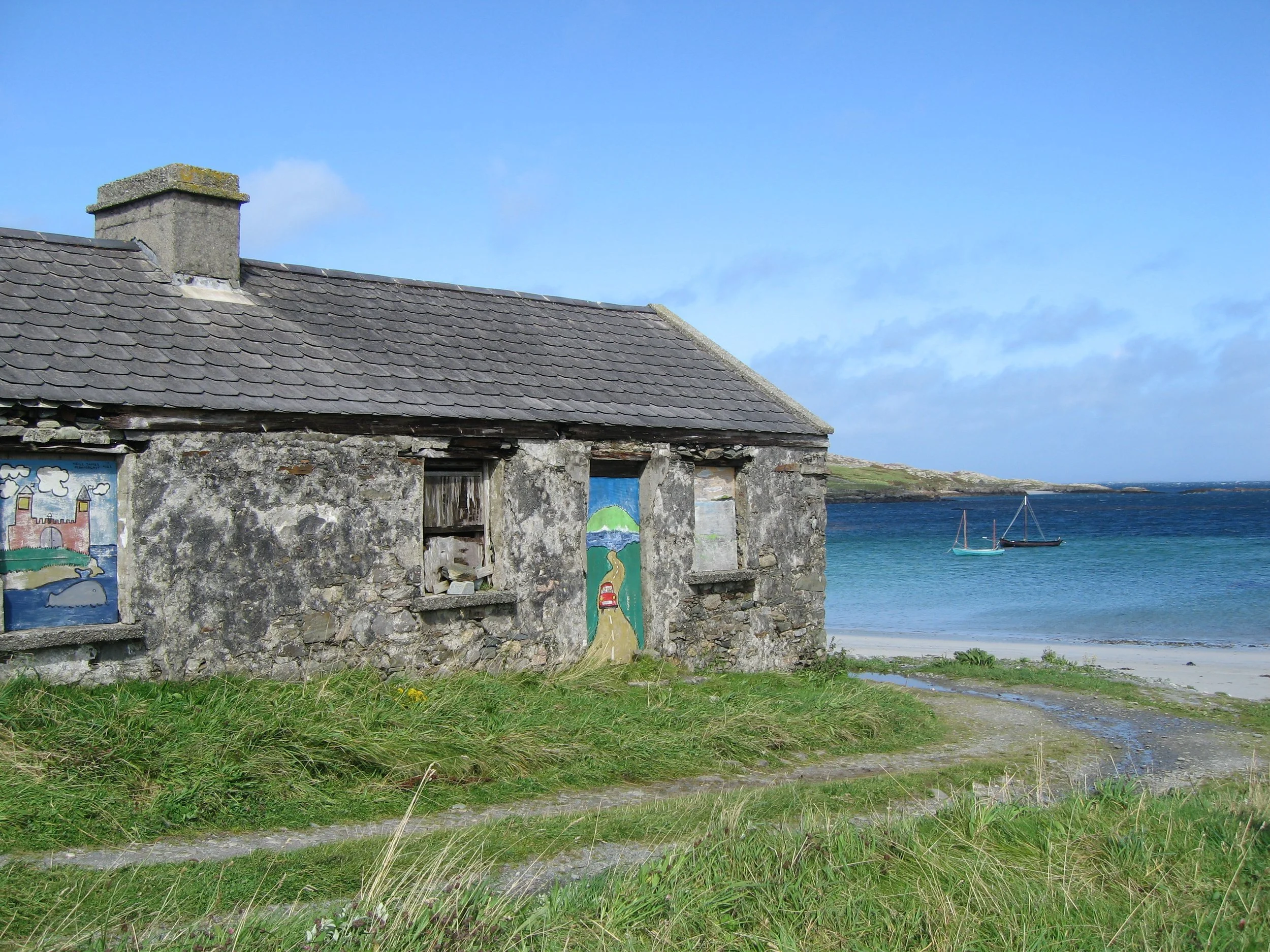
This went on for another week. Then one day the island looked like the morning after a fancy dress ball: tattered and sad. The tourist season was over, and the island put away its dancing shoes for another year. The island turned back into a pumpkin and I took up the life of Cinderella. I moved into a damp cottage a few feet from the seawall in the eastern village of Rusheen. No sink. No toilet. No bath. £25 a week—turf and milk included. Eighty years ago Rusheen was a swarming village of thirty houses with some nine people in each house. It had a jetty and a busy fish curing station. Now it was a shipwrecked village of cold hearths.
A circadian drama of changing tides, weather and people.

Writing by daylight—or candles and parrafin lamps
My tiny window stared out upon a circadian drama of changing tides, weather and people. One hour a grey sea flowed up to my door, and another hour a cold desert of sand and brown tangles stretched far across the bay. The distant peaks of the Twelve Pins of Connemara bleached and faded under the sweeping sunbeams, and blued with cold under the brooding clouds. For sound effects, the sea crashed and slapped over the rocks and they clattered like bones.
Coming and going were donkeys to and from the bog; kids in hooded wool coats like wet sponges, to and from school; squeaking bicycles to and from the pub; mothers and rattling prams with little ones bundled like mummies to and from the shop. Sometimes a lone figure crawled and stooped among the rocks, picking periwinkles from the seaweed for the plates of France. But the ruins of the fish curing house at the end of the quay, and the old broken hull beside it never budged.
I was happy. I shyly started up the whistle classes, and the kids eagerly flocked to my cottage in all kinds of weather. But I had one problem: I was always sleepy. I complained to Henry Lavelle, a 10-year-old.
“'Tis the heavy air that makes ye dopey,” he said.
“'Tis the salt that takes the puff out of ye,” said his younger brother Francis.
I thought it might have something to do with the parrafin oil, turf, coal, sulphur and cylinder gas fumes I was inhaling. Outdoors I was breathing the purest air my lungs had ever known, but indoors the pollution level was staggering. Coffee, tea, coffee, tea—I was swallowing buckets of it to keep from passing out.
I was exhausted by the endless housework of dumping ashes and tea grinds and garbage pails and plastic toilets; hauling sacks of turf and filling and emptying tea kettles and hot water bottles and pans of dirty dishwater and plates of turnip peels; sweeping mud and turf crumbs and boiling sheets and blue jeans and filling oil lamps and building and blowing fires. And then one night something happened. I think the island was determined to have me reckon with its hypnotic air and its other forces as well.
Spooked!
I burrowed under my mountain of blankets, and fell into a deep sleep in a room so black there was no up or down. Hours later something jerked me awake. I felt a heavy presence breathing over me. I felt a needle pricking my left wrist and a dry scratchy thing being forced down my throat. I bolted up in the bed. I blinked in disbelief. The room was still black, yet floating over my head in a garish orange light was a puppet-like face with a hooked nose and slit eyes. Black tattered shapes hovered around it. I squeezed my eyes tight and saw reassuring darkness. But when I opened them again it was all still there. Frantic, I muttered some holy words to the dark. Then I watched as the orange light and horrible things inside it dissolved, and the room became black and peaceful.
The next day a woman from a neighboring village stopped by with some turnips and two weeks’ worth of newspapers tied up in a string. She wanted to know how I was settling in. “I'm doing just grand,” I said. “But last night I think I had a visit from the fairies.” “Faith, tell me! What is it?” she asked, sucking in her breath. Over tea I gave her the full details. I wondered how fast they’d get around the island and into what fantastic shapes they would grow. But while I laughed, she stiffened. “Well now…”she said hesitatingly. “I hate to tell ye this but…there is a thing about this cottage.” I lurched forward and clutched a turnip. Did I really want to know more? “A man who was staying here heard a tap at the window late one night and a voice calling his name. He got up and looked out the window but saw no one. He was annoyed to be wakened like that, so he roused a neighbor and they went out fishing. They went out in two curraghs that night. But his curragh never returned.”
My pounding blood stopped. I knew that I had come to a wild remote island with a dark history. An island where savage things did indeed happen. The Inishbofin nights had not been exorcised by electricity. Nor had the imagination of its islanders been tamed by technology. But it was hard to believe that I’d come all this way with my accordion and tin whistles to end up in a cottage that was haunted by fairies, or whatever they were. It felt stranger than fiction. “And I dread to tell ye—” she continued, “—but a woman who lived here—her name was Nancy—was cooking over the open fire one night when the big cooking pot suddenly flew across the room. She's dead now. Died at thirty-four.” “That’s my age!” “You could change bedrooms,” the neighbor offered lamely. “That's what the O'Malleys did. They were sleeping in that bedroom there, but after a week they moved to the other one." “Why?” “Faith, I don't know.”
By now I was in stutters, and it wasn't the coffee. After the woman left I pulled on my Wellies and walked straight to Lena’s and told her my story. “Faith, there’re enough stories goin’ round this wretched island,'” Lena said. “I never heard anything about yer house but that lightening came down the chimney once and fired the cooking pot across the room.”
Seeing my collapsed state, Lena offered to let me stay at her place until I felt calm enough to move back into the cottage. Her husband Ned was sympathetic about my condition too. But he didn’t believe in fairies and couldn't resist using the occasion to show me. I was huddled in front of the fire, still mulling it over, when he poked me on the shoulder. “There's yer fairy,” he laughed, pointing across the room. On the table beside the teapot was a plastic bottle of Saxa-brand salt he’d shrouded in a white tea towel.


A faceful of nettles
Saturday brought a cold-blooded rain and Saturday’s wind was a faceful of nettles. But Saturday night was a big night in the pub and only a hurricane would keep islanders away. The road from the east was a big mud pie, and the potholes gargled as we plodded, my Wellingtons and I. My oilskins slithered as I passed the graveyard and I gave a nod of respect. Then I saw a light bobbing on the road. As the two women approached the torch swept my face and one shrieked, “This one's not of this island!'”
“I'm the tin whistle teacher!” I shouted into the wind and the woman recovered her senses. And two hills and three donkeys later I heard the great stuttering heartbeat of the hotel generator and felt relief to see the great light of the pub.
In one corner some gray and brown men were staring at the gozzlebox. Another gray and brown clump was reading the flickering fire and the Connaught Tribune. Another batch of bachelors was gambling at cards for stakes of chickens and mutton. And around the big U-shaped bar, like weary horses pulled up to a corral, were five brown foaming pints parked beside five old rusty bicycle lamps, the kind you crank to turn on.
'Now that's a fine old lamp,'' I said to the old man next to me, thinking with regret of the cheap plastic flashlight I'd brought to the island. More than once on the three-mile walk between my cottage and the pub, it had flown apart like a jack-in-the-box, its head popping off and its batteries rolling down the road in the dark.
“So 'tis a fine one,” he said. “Bought it for two shillings twenty years ago. ‘Tis the boy-o you need on a night like this, along with a diver's suit to get across them potholes. Ye’d have yerself drownt or kilt in them, surely. Or maybe break yer back. Ah ye’d think the back was only an ould muscle and bone, but I seen skeletons in the graveyard popping up—t’is so crowded in there—and the back’s a complicated ould piece’a work.”
Just then an oilskin streaming with rain blew in the door. It slithered to the bar and a skinny old hand reached out and laid another fine old bicycle lamp on the counter. Mary was only down to buy fags and a bottle of orange, she said, for the pub wasn't the place for a family woman to be seen. But we fell into chat…
Inishcoffin
“I'm still recruiting for my tin-whistle class,” I said playfully. “Would you like to join up?”
“Well, aren't you a great girrul to bring music to the island—and in the furies of winter! If there's a purgatory, this place is it! Gales and storms and rain and rheumatism and colds and dirty old turf fires and hissing gas lamps and hail and flu and pneumonia and nothing to do for amusement. An ould Inishcoffin. This weren't no place for holiday makin'!”
“I'm not exactly on holiday,” I said. ''I'm here to pass a quiet winter and do some writing. Would you like to learn the tin whistle?”
“Well you reckon I could play it fer the donkeys on my way to the bog? Heavens child! I'm not a’tall musical, but I used to dance. Oh the dances we had here when I was young. From noon till dawn! There were twelve hundred people on Inishbofin back then, and four hundred others over on Inishshark. That’s th'island ye can see over there beyant that strip of water we calls the Dirty Sound because ‘tis so treacherous.
“When I was a courtin’ the Shark people'd row over in their curraghs on Sundays for mass and to buy tea. But t'was only an excuse for a hooley, a party. All the people's gone off Shark it now, moved off it by the government in ‘56. ‘Tis sad, really to see all the cottages in ruin. Some German owns the island now. Says he’s going to fix it up for tourists with an airstrip and all. But he’ll have to bargain with Lucifer to change the weather!
“When I was a girrul t’was so warm here we'd run barefoot all summer and there’d be fishin’ up until after Christmas,” she went on. “But we're shiftin’ out of the Gulf Stream I do believe, and th’island’s gettin’ to be an ould iceberg. Bofin was like a gold rush in them days, with people comin’ from everywhere to fish for mackerel and cod and ling and plaice and pollack and crabs and lobsters. Our harbor was one of the best in Europe, and many a stray ship would take shelter here.”
“One of the best in Europe? Really?”
“I’m tellin’ you, girrul!” said Mary. “Known far and wide. The world over. Them Norwegians would be comin’ all the time with their fiddles—could they dance! And the French—you'd give ‘em a bottle of milk, and they’d give you a bottle of Bo-jo-lay. But the Frigidaire got invented. Kilt the salt-fish trade overnight… In them days this island was self-sufficient, too. Every inch was farmed. We’d pull the grass from between the cracks in the stones to feed the cows. ‘T’wasn’t anythin’ we didn’t eat that didn’t come from th’earth or the sea. Now ‘tis only an island of tin openers! Now ‘tis only an ould Inishdole !''
Living from the sea
I believed Mary when she said Inishbofin hadn’t suffered as severely as Ireland during The Great Hunger between 1841 and 1851. The potato blights brought rampant misery and starvation to all on the mainland who’d been forced by government policies to depend on this staple crop. Inishbofin lost one-third of its population during this time, but it was to a cholera epidemic that started when a diseased corpse washed ashore on the island at Scealp na gCat. Despite Inishbofin’s overcrowding during the famine years, islanders managed to survive because they knew how to live from the sea.
But did they now? With the sea all around me, I couldn’t even get a fish. In 1820 Bofin was one of the biggest fisheries on the Irish coast, with 10,000 herring fishermen converging on the island all at once. Its harbor was a traffic jam of big masted ships, nobbies, rowboats, pucáns and currachs. But now I had to pay a neighbor to bring me some mackerel from a shop in Galway. And I was thrilled skinny to receive a tin of tuna fish postmarked San Francisco, sent as a joke by a Sunset Magazine editor with whom I’d been corresponding.
An overpopulated island
A hundred and fifty years ago there were some 1500 people living on Inishbofin. The Irish Congested Districts Board considered the island overpopulated, yet on 3 1/2 acres of land, each family managed to grow enough oats, barley and rye to feed their fowl and livestock, and enough potatoes and turnips for themselves. Eggs were so plentiful they were exported to the mainland. Daring Bofin fishermen harpooned seven-ton basking sharks for the precious liver oil, burned in the lamps around the world. Islanders managed fish-curing and kelp-burning industries. Women carded, dyed, spun and knitted. The island had a carpenter, blacksmith, boat builder, weaver, tailor, sawyer, one public house, and three small shops.
There were still three small shops, but what did they sell? Gray splotched carrots that looked like leper's fingers, whiskery turnips like shrivelled walrus heads, boxes of wallpaper-paste-flavored instant mashed potatoes, and real potatoes imported from Holland. It shocked me to see islanders buying white bread loaves baked on the mainland, eggs, butter, and onions from Galway, and Long-Life, evaporated and powdered milk.
A mother of five had tried to explain it to me by saying how there weren’t the people to do the labor on the island now, with all the young ones gone off to the cities. But the logic failed. Did it really take that much effort to plant a few rows of squash or beans? Well maybe. Planting beans would involve tying them up on strings and poles and looking after them.. And xenophobia counted for something. Some French visitors had brought an aubergine to a young farmer I’d befriended. He’d laughed at the “vegetable from outer space” and thrown the eggplant to his chickens.
I stared at Mary’s wizened face looking out of the oilskin hood and I said again, “How can it be?”
“’Tis a queer thing all right,” she said, “and ‘tis even queerer that everybody on th'island agrees that ‘tis a queer thing Some people say the cooler summers were making the growing season here too short, and others says we're just too lazy.”
Mary had just come down to the pub to buy some cigarettes and a bottle of orange, and had been talking and dripping for over two hours. It was getting late. I reluctantly turned my thoughts to my cottage. A few more hot whiskeys and I'd throw the fairies out on their ears. I started to tell Mary about my visitation from the fairies when suddenly the pub lights went out.
Lights out
The generator had a coronary. The lads at their cards struck matches to see their hands. The beams of the old bike lamps dueled in the dark while the maid behind the bar fumbled for some candles. We stuck them on saucers, and suddenly the pub looked like an elegant dinner party! I told my story, now to a flickering face lurking out of a dripping hood. “Well now, maybe ‘twas a window peeker ye saw,” Mary said. “A window peeker? On Inishbofin?” “Don't be fooled. There’s all kinds on this island. Ye’d want to keep yer curtains drawn and yer door locked at night. And if ye see any o’ them fairies or puppets or flyin’ saucers, ye could always keep a night candle going and put a little holy water by yer bed.”
I left the pub in great form. I trundled up the hill, bid good-night to an old man mounting his old push-bike, and passed two glowing cigarettes mumbling by a stone wall. The next day I would move out of Lena’s and back into my cottage. Fairies or no fairies.
Sunday morning was deliriously sunny. I awoke feeling courageous, but I took an empty bottle to the church anyway. After mass I sheepishly asked one of the little girls where I might find the store of holy water. She giggled when I asked, because she knew I was not Catholic. She’d heard about my troubles with the fairies, and pointed to a large stone urn.
I discreetly took out the empty shampoo bottle and thrust it under the holy water, coughing to muffle the gurgles. When I got back to my cottage, I nonchalantly sprinkled the water over my bed, over the windows, over the floor, over the geraniums, inside the drawers, just to make sure, then stashed the rest under my pillow. I felt sound. But as dark came down, I felt the willies coming on. Before I crawled into bed, I lit a votive candle, put on a tape of merry jigs and gulped a few whiskeys. I felt ridiculous. But you wouldn't know what there was or wasn’t in the fright of the night on Inishbofin.
Settling into island life
When I stopped groping for a light switch on the dark mornings and fumbled for the box of matches instead, I was settled into island life. But I still couldn't get the islanders’ names straight. Because they were all related by blood or marriage, there were only 17 surnames on the island. But the variations on the first names had me perpetually confused. There was Michael Joseph and Michael John, but they’d be called Mickey Joe or Michael Joe or Michael or Mick or Micho or Joseph or Joe or John or Mickey John. And the women went by their married names and their maiden names and their nicknames, so the gossip was hard to follow sometimes.
I gave up contact with Dublin and Ireland and the rest of the world. The news on the wireless was only scratchy noise from a distant star. And the public telephone box two miles down the road was truly as someone described: “a fine toy for a child.” The telephone equipment was World War II gear and the weak radio signal was subject to weather interference. When the phone worked properly you’d wait up to half an hour for the Bofin post mistress to get you through, even to Galway. Then you'd have to bellow into the receiver, so that she and everybody passing by the road knew your business—if they weren't already listening in on one of the ten island phones all strung onto one party line. While waiting for a connection you might be privy to a cross-stitched conversation like this:
''Yes, send me out some bacon, please. I need fifteen pounds.'' 'Surely, and what color, green or blue? And with ruffles?'' ''Why of course, like the last order…Tell me, they do be sayin' that last week there Henry was dreamin' he was kickin' a rat, and he broke his toe on the bedpost. Would that be true?'' ''Faith, yes. 'Twas green, and it had ruffles.''
“Slicer Lyon” they called me
I helped a neighbor dig potatoes and got the nickname Slicer Lyon for the method I had of cutting up the potatoes with the spade before I got them out of the ground. I took long walks in the mist, in the rain, in the sun, in the snow, to the tops of wild cliffs, looking out over frolicking dolphins, and down into the jaws of the rocks to watch seals diving for fish. One morning I walked to the edge of Trá Gheal, the bright pearly strand with a treacherous reputation.
At this beautiful spot four different currents converge at 13 knots, and the sand is so quick it’ll suck you in up to your shoulders in minutes. On Easter Sunday, 1949, three Lacey men set out from this beach in their curragh to row the mile back home to Inishshark. They’d hardly gotten the boat offshore when the converging currents snapped the oars and dumped the men out of the boat. The quicksand did the rest. Only the shattered oars were found.
One evening I wandered down to the harbor and saw a solemn assembly of cows and men silently waiting for the tide to rise. The Glorius was docked by the quay and the Harbourmaster stood on board. After the tide had risen I watched a drama of agony as the farmers tied ropes around the cows bellies and a crane hoisted them high with splayed legs and gaping mouths into the crowded boat bound for market. The tension and silence was frightening, and the harbormaster stood with his arms outstretched as if giving last rites.
I hiked the island from one end to the other, making house calls as the itinerant tin whistle teacher, while the island’s petty reigning monarchs, the priest and the schoolmaster, bickered over the after-hours use of the schoolhouse for tin whistle classes. One blustery night in a warm house filled with tin whistles and balls of wool, the mothers and I were discussing these “negotiations.”
Brandishing her knitting needle one cried, “ ‘Tis ridiculous ye can’t have the key to the schoolhouse for yer lessons! What’er ye goin' to do—go in there and steal the crown jewels? What's this about the priest havin’ to ask the schoolmaster! Who runs this island anyway? I thought it was the priest! I thought he was head man!”
Despite the freezing damp of my cottage, I survived Granuaille's Curse, a three-week siege of flu, colds, tonsillitis, and wild stomach pains that had me crawling on all fours to get to the turf pile. Word of my malady brought a visit from Sister Reginald, the nun who was filling in for the island nurse while she was on holiday in America. She arrived with the priest himself, an affable young man with a Campbell's soup kid face who’d been sentenced to three years on Inishbofin by the parish in Tuam.
Sister Reginald came with ravishing energy, motherly love and a prescription for brandy. Father O’Gorman came with interior decorating hints. “You could move the sofa closer to the fire,” he suggested “—and hang a blanket over the door to keep out the draft.” After studying the gaping space under and around the rotting door, through which the sea spray sneezed, he concluded, “What you really need is a snake.”
The Sister grabbed the bódhran from over the fireplace and whacked an impish beat on its leathery skin. The Father blew his way through my arsenal of tin whistles. Then as suddenly as they’d come, they were off to pay another call. But halfway out the door, the priest offered his counsel. “You really ought to get off the island every week or so, even for a day. You can go a bit funny here, when all you hear for talk is ‘Did the boat go?’? ‘Will she go?’ ‘Is she in yet?”
It was easy for the priest to come and go off the island, and this offended the islanders who couldn’t. He kept two cars, one on the island for short zips up and down the steep Inishbofin hills, and the other in Cleggan for his jaunts around the Irish countryside. He was never seen walking. Once, his speeding Volkswagen almost ran me down on my daily jaunt to heave the contents of my toilet bucket over the sea wall.
A ramble to Galway was like an excursion to Paris
The miraculous lights of Renvyle and Cleggan sparkled across the bay like beacons of a dream world, but I never left the island for even a day. A day might end up being a week if the sea got rough. The boat and taxi and bus fares to Galway amounted to £20 one way, and hitching was tricky. On the lonely ten-mile road from Cleggan to Clifden, cars were as rare as sunshine. A ramble to Galway was like an excursion to Paris. That's why some islanders spoke of Ireland as a foreign country and didn't go off the island for years.
Inishbofin was tiny world but it was the whole world. Every single islet, rock and ridge and cove and cliff and gully and reef and blow-hole and scrap of bog and beach had a name, and each of the 300 names told a story. Oogh being the Irish word for cove, the map of Bofin had an Oogharlea, Ooghnastrappy, Ooghnacappul, Ooghnacronlach, Ooghnadoby, Ooghacat, Ooghnanunsa, Ooghnavaud, Ooghnagaragh, Ooghnageeragh, Ooghaveagh, Ooghnacronlach, Ooghnashinnagh, Ooghnagunnel, Ooghnacarrick and so on. In the same spirit of grandeur, the five miles between the East End and the West End might have been the See America Greyhound Route for the way the islanders talked about the vast cultural differences between them —
“Ah th'east is more civilized, but 'tis not as friendly. The people there do be keepin' to themselves.”
No secrets and no escapes
Here there were no secrets, and no escapes. You could find every quirk and caper of human nature if you looked for it. Island families who hadn't spoken to one another in generations, and others who hadn't gone from the West Village to Rusheen, or from Rusheen to the West Village in twenty years. Inishbofin was psychically marooned by the formidable boundary of the sea. On its northeast cliff side carved jagged by ferocious Atlantic breakers, the known inhabited world dropped off into waves stretching to infinity. On its harbour side, another country called Ireland lay not so far across the water, but the people lived there had alien habits like riding in buses and eating in restaurants.
With its reputation for enchantment, and its gaudy harvest moon, Inishbofin seemed like the perfect place to celebrate Samhain, All Hallow’s Eve. The island schoolmaster, a proper sort of fellow with 18th century sideburns and a natty tweed suit, was quick to advise me that Halloween capers had been dead out on Inishbofin for over 20 years. “There’ll be nothing doing on the island—nothing at all,” Eugene had huffed into his brandy snifter one night at the pub. So when the 31st of October came, I prepared for another night of writing. I popped a batch of corn, lit my host of candles and loaded up my typewriter with another piece of damp curly paper.
Between faltering taps of the typewriter keys I heard a tap at my window. The door blew open and my cottage was swirling with terrifying specters swinging carved turnips with leering fiery eyes.
My whistlers! They were reviving the Celtic New Year charade. I screamed with delight. I offered them popcorn. I blurted out, “Could you use a spare ghost?”
There was a long excruciating pause. The ringleader turned to confer with the others. Then, to my delight, one of the lads offered me his own refuse sack to use as a costume. I smeared Maybelline blue rings under my eyes. I blackened my lips with eyeliner and pulled a green bathing cap over my scalp. Then off we went, tumbling along in the windy darkness, screeching our tin whistles to frighten or banish whatever else was on that road.
By and by, we came to a house with a great light. We rattled and banged on the door. The latch was turned, and through the half-open door we spied a roomful of souls bewitched by the eerie flickering of a battery-operated TV set. They slowly turned their heads to see who was at the door. They slowly turned them back to the Radio Téléfis Eireann special on the origins of Halloween. We stood there in the doorway, watching them watching the television. That was all. We left without a word. Without a toot from a tin whistle.
Eggs frozen in their shells
When the coldest temperatures on record in Ireland hit, and the egg yolks froze in their shells, I put on my hat and my mittens and went to bed with some poems and two hot water bottles for three days. Three days became three weeks. Christmas came and wild gales drenched the island in an icy depression.
I would gladly have slept through December 25th and the Sumo wrestling wind and nails of hail. But I dragged myself out of the only warm place in my cottage in late afternoon to cheer a lonely neighbor with a special imported treat—a tin of jellied cranberry sauce. We celebrated a Tin Openers Christmas without tinsel or pretense.
What better cure for this mid-winter depression and social rigor mortis—a Bofin wedding! Since the day I arrived on this island, I have been hearing about the wedding in the same important tones the outside world reserves for coronations and inaugurations. A Bofin man is about to marry a Dublin woman—and despite the wretched rain and gales and 17-hour nights, the island springs back to life!
Oh the wonderful hysteria! The sewing, the run on eye shadow, lipsticks and stockings and in the shop, the practicing of struts in high heels, the baking and the tasting and the polishing of hotels. Supply lists are drawn up: more nylon stockings and more boxes of home perms and marzipan and RyVita crackers for the dieters, and cases of champagne and barrels of porter and a mammoth salmon and sacks of rice, and lace for the bridesmaids' dresses and smooth wooden planks for a dance floor!
The hairdresser arrives, and women with wet permed heads crowd into a makeshift beauty parlor to share one blow dryer. And the men are getting their suits pressed. And the boat flies back and forth from Cleggan packed with friends and relatives from Dublin, and island children back home from boarding school in Tuam and immigrants from everywhere!
The night before the wedding there is a stag party for the men and a hen party for the women, and at an appointed hour they mingle. Through this endless night I meet Esmeralda and Tony, the sister and the brother of the bridegroom, who talk with regret about their exiled lives in England and how they hate to see their island becoming a holiday resort.
I meet the overjoyed parents of the bride, who've never been to Bofin before but have fallen in love with the islanders. I meet a Belfast architect with a holiday home here who is seeking a grant for a community hall for the island, while his American wife envisions yoga and macramé classes. I dance with Andy, an effusive young Dublin journalist and poet, who after 24 hours here is calling Bofin “Ireland's answer to Paris” and threatening to tie himself to the pier and never go back to “The Big Smoke.”
Two hundred and fifty people are invited, but 400 show up at the bridal dinner. After a diet of turnips I go wild at the sight of pâté and roast duckling and Charlotte Russe. After dessert, the dance floor is laid. Glamorous dresses and spiffy suits pour onto the makeshift ballroom. I don't recognize the islanders out of their oilskins and they don't recognize me in a dress.
Accordion bellows are unstrapped. Sister Reginald lashes into a wild leathery beat on the bódhran she has secretly been learning to play. The priest waltzes and sweeps his way around the room. And everyone is flirting with everyone! Never mind that after the fabulous wedding the couple will have to go on the dole to stay on the island—tonight is the happiest night of their lives!
We party for days and nights until the dreadful moment comes when the boat must carry the wedding guests away. The jobs back in London and Manchester and Belfast and Dublin won't wait. Standing on the quay watching the good-byes, I feel like I’m watching a coffin ship sailing off with famine survivors, such is their trauma at leaving the island.
Exiled hearts
Whatever the hard life on Inishbofin, the treachery of wind and fear of sea and small world monotony, this piece of land wrenches these exiled hearts like the vision of stars sprinkled in a pothole puddle. As I fix on the tear-stung faces I wonder how I will ever be able leave. Will two more months of turf fires and eyestrain and risk of hypothermia cure me of this island infatuation once and for all? Will I be ready to say of Inishbofin, “It's the most beautiful place on earth, but it's not enough,” and step aboard this boat and say good-bye to my tin whistlers and the little road and the waves rocking me to sleep at night?
When tourism seems to be the island's only future, will I one day return to find Bofin's heather hills scarred with glass, its old ones in the boneyard and their hearths on loan to city seekers of the quaint life?

Black tarred traditional curraghs overturned on the shore looked like huge beetles.
My return visit to Inishbofin
On a nostalgic return visit to Inishbofin in 2012, I found the same potholed road and the same gale force winds, but a new life, highlighting tourism of course, and younger settlers. The old cottage I had stayed in was a ruined shell, surrounded by new-built holiday cottages—with heat!—but the old fish-curing house was still there, and the view of the Twelve Pins of Connemara had not changed.