

Irish Pub Etiquette
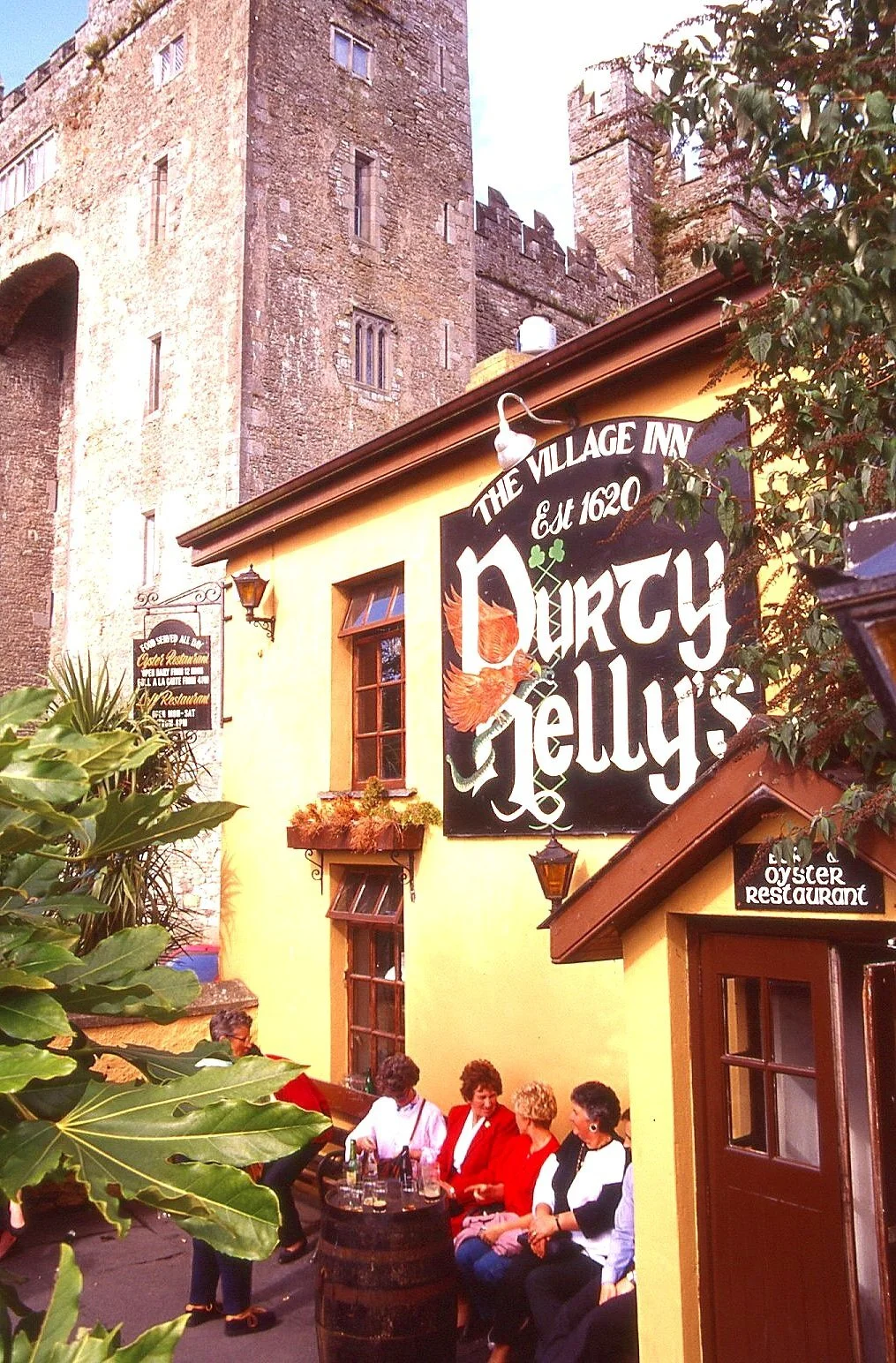
Durty Nelly’s Pub at Bunratty Castle

Dublin traditional Irish music session
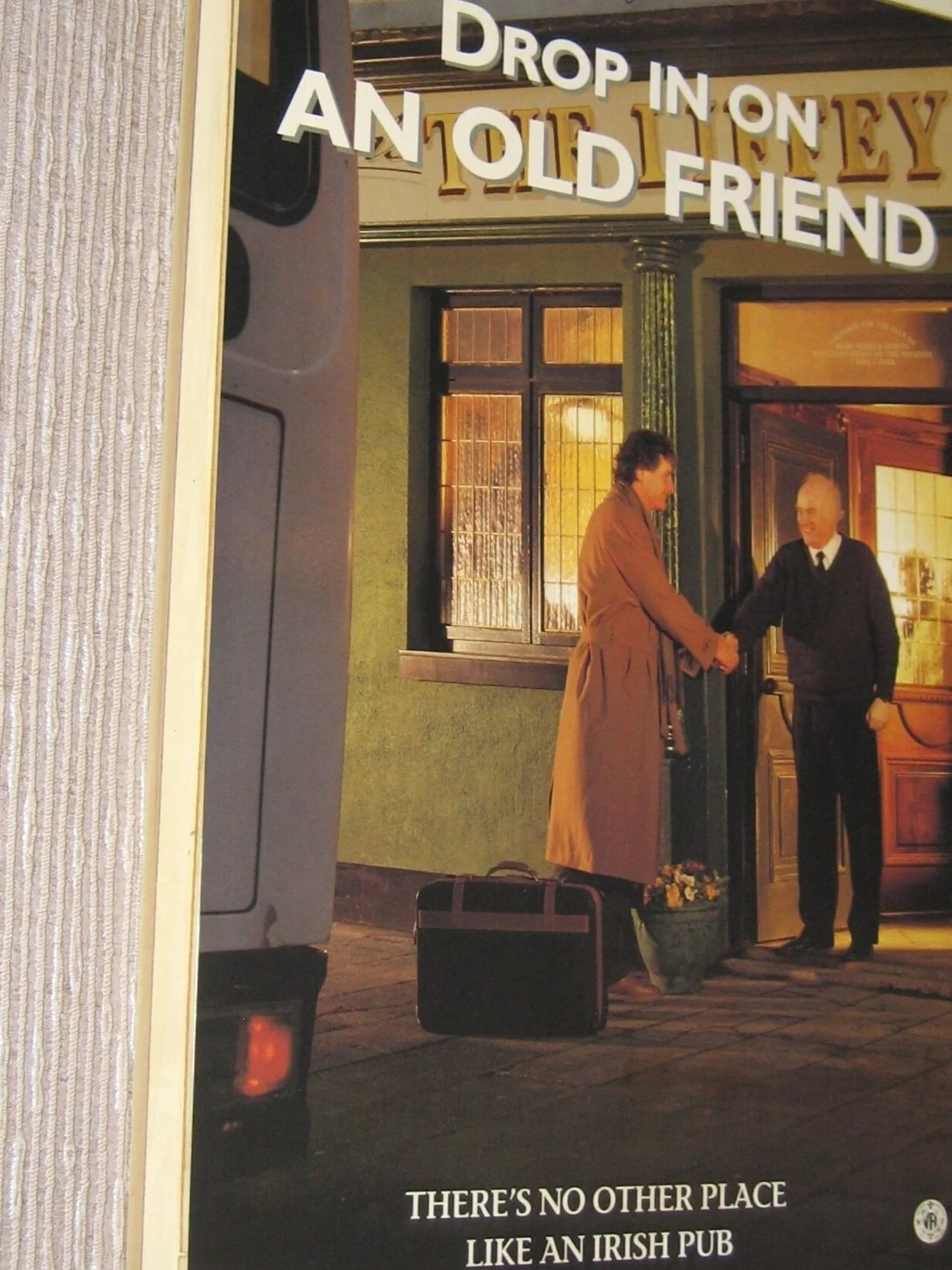
Poster promoting Irish pubs
“I was only a tourist in Dublin, trying to learn the tin whistle while on the lookout for freelance writing assignments. I showed In Dublin Magazine editor David McKenna the article I wrote for the New York Times on Paddy Moloney and The Chieftains.
The magazine’s Irish Music columnist had just left for the continent and David asked me to write a column in his stead. I thought he meant for me to write just one article—not take over the whole column! Suddenly I found myself going to pubs and other musical venues every night, alone, to get material and do reviews for the column. ”

Pepper’s Pub in Feakle, County Clare
“I had no budget for drinking and no proclivity for drinking like the Irish. But I loved the sociability of the pub. Sometime I would just ask for a glass of water, slip a fizzy Ribeena tablet in it so it looked like a soda, and nurse it all night long, hoping no one would notice. Because you COULD NOT sit at a table in an Irish pub without a glass in front of you. Especially an empty glass!
But how did the Irish drink? It seemed from the outside, that there was an etiquette about it, rules, expectations, rituals, that were all invisible to me. I spent weeks and weeks researching this little piece, asking drinkers and publicans about this mysterious drinking etiquette. Did they tell me the truth? I’ll never know. With many pubs in Ireland closing, and stricter DUI laws and more drinking at home, you’re not as likely to find yourself in 16-person rounds, as before. But you never know!”
Irish pub etiquette is as delicate as stout foam
Irish pub etiquette is as delicate as the head of foam on a pint of stout:
You offer him another drink.
He says, no he's all right thanks, and, sure America must be a grand place.
You say, are you sure you won't have another?
He says, no, I won't.
So you signal to the barman for one refill instead of two, and suddenly the gush of chat and charm slows to a thin miserable dribble. The man at your sleeve looks balefully at the rings of foam in side his empty glass, and then petulantly at the television. You were just getting ready to tell him about your Irish roots, the Caffertys of Tooloobawn, Kiltulla—but his stool is now empty.
You blundered. You committed the deplorable, the unforgivable, the greatest offense and atrocity against Irish pub etiquette. You didn't ask yer man a third time if he wanted a second drink, and with boldness, joviality and dash.
Sure you didn't even give the man a chance. He was only waiting to be asked again, having twice refused so as not to seem too eager or God forbid, an alcoholic, and he intended all the while to relent on the third time and say with shyly downcast eyes, “I don't mind if I do.” And then the chat would have bubbled on, exploding with a newfound, profound effervescence.
Now you know. A night in an Irish pub can be a madcap display of wit and malarkey, or funereally sodden, morose and boring. One night a cozy turf fire, a jovial publican, jigs and fiddles, singsong and yarns. The next, a row of old necks craned toward the flickering gozzlebox for “Dallas,” with nary a word spoken, grunted or hurled.
The Irish psyche is more tangled than the knot work in the Book of Kells. You will never ever unravel it, but knowing something about Irish Pub Etiquette will enhance your enjoyment of pub life, for many the only life in Ireland.

Rounds
A group insurance policy against sobriety; a highly complicated ritual involving any number of people, in which drinkers who are pub-crawling together, or those collected within a certain “circumference of attention” each buys a round for the group. Everyone is expected to drink at the same pace—age, fortitude or gender notwithstanding. And everyone must buy—even the ladies. (These days, women are expected to buy back drinks, although men usually buy the first round.)
The lofty price of the pint has worked to reduce the size of the once epic-size round these days, but we still hear reports of 30-person rounds, and there are even those who would snigger at this low figure. If you prefer to drink “on your own,” neither accepting nor buying drinks, be prepared to be regarded as “mean”—stingy—aloof or ignorant, and henceforth left out of any decent conversation.
Holy Hour
“They had to call it something comical,” says one about the hours (2-4 p.m. Sundays) when pubs close to wash up glasses, sweep out cigarette butts and throw out drunks. This tragic policy of closure pertains more to the cities of Dublin and Cork than to small towns and villages.
Stout, Porter, Guinness And “Pint Of Plain”
These names all refer to the same drink. As well, a “half pint” is the same as a “glass” and a “small one”—small’un—is the same thing as a “whiskey” or “half’un.” So don't make the faux pas of sauntering up to your publican to order two pints of porter, a stout and a Guinness, a glass and a whiskey, a half pint and a small one and a pint of plain!
Jar And Jorum
These slang terms for a pint originate from the days when a pub was just a room with some old barrels of porter, and you had to bring you own “jar” or “jorum” from which to drink. It should be noted that these terms are applied only in tweedy-capped chat about drink, and discussions of bouts and binges and such. So don't ask the barman for a jar or jorum unless you want to be taken for an ee-jit silly Yank.
Collar
This is not what you wear around your neck, but the head of foam on your pint of Guinness. If it's too thick, it's a “bishop,” and if it's too thin, it's a “cardinal.” Remember to use these terms when registering your complaints with the barman.
On Buying
A pint buys jokes, preposterous yarns, false compliments, genealogical info and sometimes even friends. As we have said, always offer at least three times. If you should feel intimidated by this little game, and lack the native poise and charm to play it, then forget about asking at all.
Simply note when yer man’s or yer woman’s drink is three-quarters gone, and nod or shout and roar and wave your arm to the bar man for another round. Timing is critical. If you wait too long to make your move, the man at your sleeve will be pressed to buy your round himself, and this is utterly disagreeable. But what do you do if you have three pints going flat in front of you, and he’s drinking so fast he’s down to the foam on his fourth? Let the chancer buy his own!
On Accepting
When being bought a drink, it is appropriate to appear surprised, pleased and grateful, even though you know the drink is only offered as payment for the one you bought, or in anticipation of the one you will buy. But false sincerity makes what is really a crass tit-for-tat appear to be a form of gift giving. It is an Irish pretense you would do well to master.
On Refusing
To refuse a drink, protest at least three times and show good cause, i.e. you have seven drinks in front of you already, you are already drunk, you’re a lorry driver off to France in the next fifteen minutes, or a champion step dancer off the stuff for the week. If you don't drink alcohol, drink something—anything—and try to keep up with the pace of the round, lest you miss your turn.
At an uproarious Irish wedding, the father of the bridegroom offered a pretty woman a glass of scotch. She declined, exhibiting her glass of soda and lime. She didn’t drink alcohol, she said.
"Well you aren't fit company for a bullock !" he raved at an embarrassing decibel.
Yes, some drinkers will be offended if you are teetotaling. Say you're an alcoholic, or already have a hangover or drink Kalibur—the non-alcoholic beer created by Guinness for these situations. (It fizzes like real and only your publican will know for sure.)
Do's And Dont's
For Men:
It's not the done thing to drink Guinness from a glass. Order up pints, men, the only size vessel worthy of your fist. Drinking stout from glasses is a feminine practice, and even the women are giving it up.
For Women:
Ladies are allowed into all Irish pubs these days, city and country, day or night, alone or accompanied by men or children. But this doesn't mean that you will always feel welcome in every venue or comfortable in every pub situation. Big lounge bars, music pubs and venues with "pub grub'' are well trafficked day and night. But in certain rural places you're likely to be the only female in the place during the day and early evening.
It's typical for a hush to fall over an uncrowded pub whenever a new person enters. Don't mind the stares and ensuing mumbles. Head straight for the bar like you mean business.
For All:
A pint of Guinness is a thing of beauty to be poured with decorum. Pulling it properly is at least as great a ceremony as pouring Japanese tea. Never, ever display impatience at the necessary pumping, scraping, topping and leveling, and never stare inquisitively at the performance. And when you have your pint in your paw, show due respect. Don't jostle or bruise it or swish it around in the glass. And never, ever, ask for ice cold Guinness or beer, or a mug with a handle.
A Final Word About “Closing Time”
The high price of drinks these days has forced Irish people to delay their nightly pub forays until an hour and a half before the closing time, of 11:30 p.m. in summer and 11 p.m. in winter. Why? Because they can't afford to go any earlier. Because they want to drink at the pace they are accustomed to, not sit there sipping sappily, measuring their money against the clock face.
Closing time is a variably timed event. Until you are hoisted out the door by your breeches, don't be bothered by shouts and roars of “Out now, ladies and gents! Finish up there!” But do stand for the singing of the national anthem.


