

Madeira is Portugal’s Floating Garden
By Nancy Lyon
This marooned Portuguese island is closer to Casablanca, Morocco on the African coast 340 miles away, than it is to Lisbon, 611 miles away. A trip to this steep and jungly volcanic isle is pure aromatherapy.
Madeira’s rich red wine will make you drunk. But so will its opiate breezes laced with oleander and roses, and its fruity reverie of pomegranates, tangerines and mangos, loquats and quince. In this floating garden intoxicated with light, flowers glow supernaturally and leaves glint like emeralds.
Black bullwhips. That’s what they look like, these skinny, long, black scabbard fish glistening in the morning sun, dangling over marble slabs at the market in Funchal, Madeira. When you buy one, the fishmonger rolls it into a hoop and stuffs its tail in its mouth like a Celtic knot work beasty from the Book of Kells.
If I hadn’t tasted one on a skewer with peppers and onions at a local restaurant—before seeing what it looked like coming out of the sea—I wouldn’t go near it with a pitchfork.

“No one has ever seen one alive,” my guide Miguel remarks as we gape at the enormous glassy, bloated eyes and rapier teeth that could pass for vampire fangs. The espada – scabbard fish – the national dish of Madeira, lives at the extraordinary depth of 2,600 feet below the sea. By the time the hardy island fishermen pull up their mile-long lines, the hideous eel-like fish are dead from decompression.
“Madeira is an autonomous region of Portugal, closer to Casablanca on the African coast 545 km due east than to Lisbon 978 km to the northeast. The island is only 57 kilometres long and 22 km wide, but its climactic zones range from subtropical to semi-arid and alpine. This rich botanical inheritance is carefully protected by the local government.”
Portuguese island ode
I’ve begun my Portuguese island ode with black bullwhips just to get your attention. But it’s really not fair. Though the espada has an evil looking eye, and at the fish market you see its barracuda teeth and wild bloated eyes staring out of a disgustingly long skinny body—it really is delicious, especially with Madeira’s wine and cornucopia of fruits and vegetables growing in every direction.➤→➤→➤
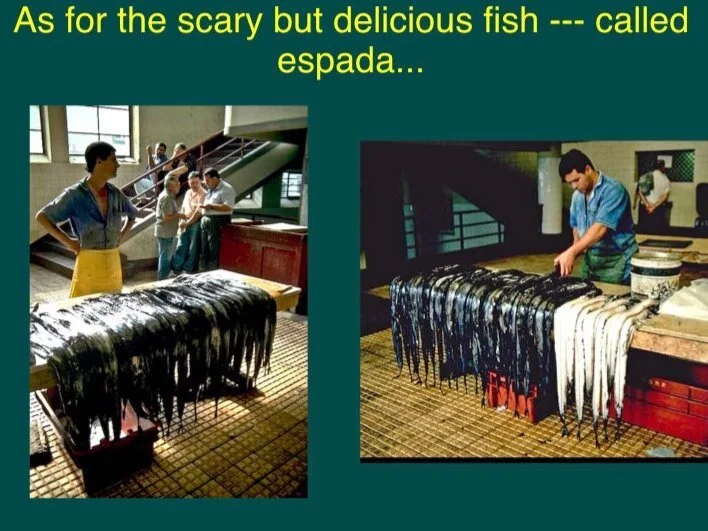
Espada - scabbard fish at a Madeiran fish market
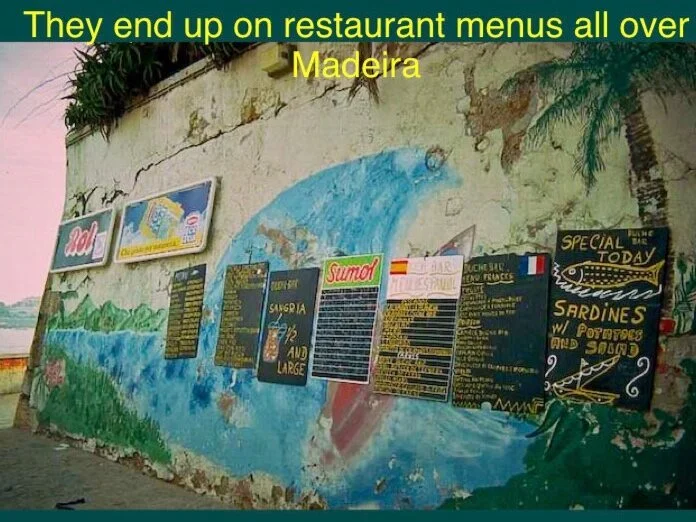
Madeira menus posted on a seawall


Opiate breezes
Madeira’s rich red wine will make you drunk. But so will its opiate breezes scented with oleander blue hydrangea and roses, ginger lilies, jasmine and bougainvillea and feathery violet jacaranda and its fruity reverie of pomegranates, tangerines and mangos, loquats and quince. In this floating garden intoxicated with light, flowers glow supernaturally and leaves glint like emeralds.
Madeira is so perpendicular that its knotted roads cling like barnacles to the cliffs. Its towns and villages are securely fastened to the coast. Its cliff-overhung beaches are polished basalt scree. And its airport runway is a ramp hoisted on to concrete pylons sunk into the sea.
Madeira’s arable land is so steeply terraced even the goats get vertigo. Staring at the celestial summit of Pico Ruivo 6,100 feet, from the belvedere of the Balcoes, you could believe that Madeira was a resurrected chunk of the lost continent of Atlantis sunk west of the Straits of Gibraltar 80,000 years ago. Or a fragment of Lemuria, the vanished land that linked Madagascar with India and Sumatra in another age. On Madeira they revere these legends.

A levada walk
Cenozoic climate
The Ice Age never touched Madeira, so it preserves the remnants of the tropical rain forest and the climate that central and southern Europe enjoyed in the early Cenozoic a million years ago – a five-month long (70°F/21°C) spring and a seven-month long (80°F/27°C) summer, with Canary Ocean currents warming the sea to 61-68°F (16-20°C).
This marooned Portuguese island is closer to Casablanca, Morocco on the African coast 340 miles away than it is to Lisbon, 611 miles away. Madeira’s soul is Mediterranean. Its culture is decidedly European. Its history and commerce are markedly British, and its mentality is 100% island.
Madeira’s rocky coastline is treacherous, but its mountainous terra firma is absolutely sublime. Botanists go bananas – and pomegranates and papaws – here. More than 700 indigenous and 120 endemic species grow on Madeira, and grow to phenomenal proportions.

Madeira’s Dragon Tree
“PORTO SANTO
Madeira is the largest of a small cluster of five islands. The neighboring desert isles of Zlheu Chao, Deserta Grande and Bugio are inhospitable and uninhabited but for colonies of a ferocious and poisonous black spider called the jycosa ingens. But Porto Santo, a 90-minute ferry ride away, is the mecca of daytripping sunbathers who come to bask on the silken 9-km-long beach whose sands are said to have curative properties.
Porto Santo’s population of 5,000 depends on Madeira for produce, supplies and tourists to fill up the four-star hotel and handful of restaurants and guesthouses.”
Madeira has rare remnants of prehistoric tropical rain forests. On Madeira's jungly slopes thrive "laura silva" - laurel woods. They're full of mimosa, eucalyptus and rubber trees with 1,000-year-old giant heather bushes 40 feet high. There's the eerie dragon tree (draceana draco), a Medusa with snarled serpentine branches thick as boas. Its sap yields a costly red dye they call “dragon's blood.”
The City of Wild Fennel
Red peppercorns! In Montreal they taste so vapid and they're $180 a kilo. On a cobbled side street in the City of Wild Fennel - Funchal - on the Island of Wood - Madeira - I spied a peppercorn tree. Its branches hung so low that I could touch the shimmering red beadwork on its branches.
My nose was full of rosemary, and the aftertaste of lemongrass, when the little red ball exploded between my teeth in tingling fireworks of peppery, crunchy, cherry and black licorice. I wanted to pick the whole tree and take it home with me. I wanted to put all of Portugal's floating Eden in a bottle and preserve its scent memories for the long winter ahead. A trip to this steep and jungly volcanic isle is pure aromatherapy.
Levadas
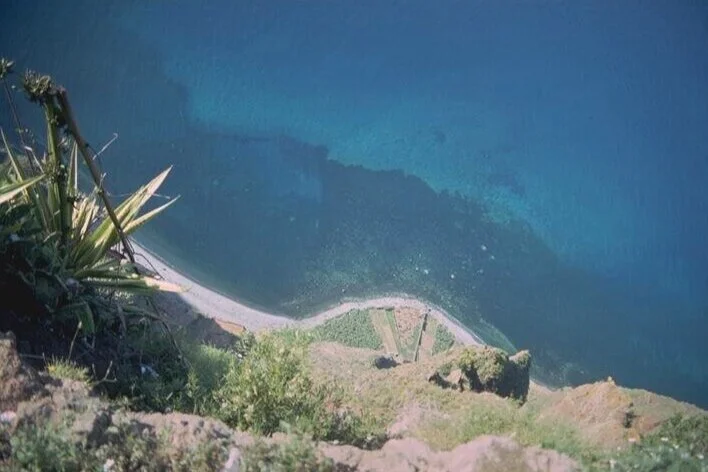
A very steep levada walk
Madeira’s lushness partly depends on its elaborate irrigation system of over 1,350 miles of levadas, which channel water from the wet northern and central regions to terraced farms in the arid south. The footpaths along these narrow aqueducts, built five centuries ago by the forced labor of Moorish slaves, make spectacularly scenic, if sometimes harrowing, hiking trails.
Some levada walks politely meander beside grassy knolls, mossy ravines, carpets of wild oats and barley, through virgin forests of heath and laurel, fields of poppies and thistles, fruit orchards and banana and sugarcane plantations. Others rudely skirt sheer drops of 1,300 feet, skim escarpments, chasms, and abysses, and pass through dark tunnels, under waterfalls and over diabolically slippery red clay.

Levada walks take you through a flowering paradise
In their meticulously detailed guide to driving and walking around Madeira, Landscapes of Madeira, John and Pat Underwood describe the challenges of certain levada walks. Of the Ponta de Sao Lourenco levada, they advise: “It’s particularly difficult for the short of leg to find footholds, especially when contemplating the foaming jaws of death below.” And on other walks they caution: "Hang on to the trees while making this very steep descent" and "Always be prepared to turn back!"
Mountain highs
Madeira’s levada walks are comparable to trekking in China for scenic mountain highs. The vertical landscapes here drive you dizzy. Cabo Girao, a stupefying 1,900-foot drop, is the second-highest sea cliff in the world.
Madeira’s short airport runway—regarded as the most dangerous in the world—is hoisted onto concrete pylons sunk into the sea. Madeira’s towns and villages are securely fastened to the coast. But its roads through the interior – crazy squiggles on the map – cling like barnacles to the cliffs. And on the steeply terraced fields representing millions of hours of human toil - even the vegetables get vertigo. But the Madeirans who live on this vertiginous hunk jutting up 20,000 feet from the seabed are a sure-footed race.
Madeira's waters are warmed by the Gulf Stream, and the island is in perpetual bloom, with a spring-summer climate that varies from 21 to 25 degrees in summer and 15 to 21 degrees in winter. Although it’s possible to leap straight into the ocean from various Madeiran hotels for a refreshing dip, most people in search of beach head for the magical silken sands of Porto Santo, a 90-minute ferry ride away.

Exotic gardens of Funchal
Funchal
Half of Madeira's population is concentrated in the capital city of Funchal (population 130,000), which looks like a Greek coliseum set into the hillside. Its whitewashed, tile-roofed houses are pitched above one another like rows of seats facing the spectacle of the sea.
Funchal's abundant parks and gardens, shady avenues, narrow cobbled streets, cafes and seascapes make for delightful wandering, but it is not a great town for museum-goers or shoppers.
At the dreary Municipal Museum housed at the Palace of Sao Pedro, you'll learn less about Madeira's history than about stuffed sharks and manta rays. And at the Casa do Tourismo across the Avenido do Mar at the harbor, you can admire the high quality of island ceramics, wicker, lace - and the high prices.
People-watching is free and best done along the harbor or at a sidewalk cafe. Stroll along the sea wall to see the yachts anchoring here on tour de monde cruises. And no visit to Madeira is complete without a sampling of the local seafood espada, and the national beverage - Madeira wine.
Sercial, Verdelho, Boal and Malmsey
I’m lucky to have Miguel Jardim, who comes from an old Madeiran wine family and knows his Sercial, Verdelho, Boal and Malmsey, to show and drive me around. His dignified English accent is not out of place here. Although Madeira is an autonomous region of Portugal, the English presence is widely visible and audible.
English is spoken all over the island, and landmarks like the villa built by English consul Henry Veitch mark dramatic moments in Madeiran history. When the Northumberland, which carried Napoleon to exile in St. Helena, anchored in Funchal, Veitch went aboard to cheer the fallen emperor with fresh fruits and aged Madeiran wines.
Reid’s Hotel on Funchal's Estrada Monumental epitomizes the genteel life of the British who sojourned here enroute from Africa and India in the 19th century. Guests have included George Bernard Shaw, Winston Churchill and deposed Cuban dictator Fulgencio Batista. Luxury suite here are fabulously priced, and tuxedos at dinner are still de rigueur, but you can have high tea and imagine the rest for a more modest sum.
Serpentine roads
Miguel drives his cousin’s lurching jeep like an old safari hand. On Madeira, car rentals are reasonably priced, but when driving here is a stunt adventure, many visitors take taxis or island buses. I learned the first rule of the road a few miles out of the capital Funchal (meaning ‘Wild Fennel’).
After lurching up a narrow road so steep it felt like our jeep could flip-flop over and slide downhill on its roof, we had to lurch back down with a wheezing banana truck in our face. Rule number one: what goes up a steep twisty one-lane Madeiran road must sometimes come back down—backwards. In Madeira the vehicle coming down the hill always has the right-of-way. Especially ten-ton trucks!
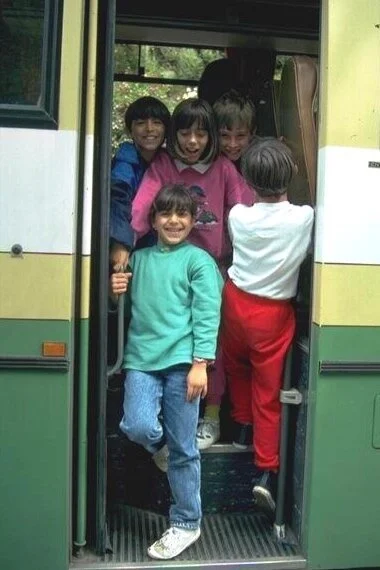
Piling into a Madeira bus
Madeiran roads are "narrrow," "torturous," "under construction," "potholed," and dominated by "macho drivers." But they are also remarkable feats of engineering, allowing traffic to average a steady 12 miles an hour. Fortunately for visitors, Madeira’s bus system transports people and what-have-you from one end of the 286 square mile, 6,107-foot high volcanic island to the other at remarkably reliable intervals. Buses are a cheap, sociable way to access the dozens of scenic walks along the narrow levadas, Madeira’s unique watercourses.
Madeiran wine
I could have walked for weeks along the levadas, soothed by the aromatherapy of the hundreds of flowery scents, the shifting light and shade, the sound of coursing water, and the pure Zen of the scenery. But there was Madeiran wine to taste and Fado music to sob over.
Miguel took me to the Casa dos Vizihos da Madeira of the old Madeira wine family company of Henriques & Henriques to taste some Sercial, Verdelho, Boal and Malmsey. During a few hours of heady sipping among venerable aged-oak casks, I learned all about how Madeira’s wine is made and new ways to serve it—as an aperitif, on ice, with lemon.
And I listened to various conflicting versions of how Madeira’s European history started out with a wayward vessel:
English adventurer Robert Machim and his beloved Anne d'Arfet fled Bristol in 1346. Either Machim was a nobleman and she was his concubine of lower station, or she was from a noble family that refused to let her marry a mere knight. Machim and his mistress and crew sailed for Portugal – or maybe that was France – but a storm blew them off course and they ended up on Madeira. The crew mutinied. Anne took ill and died. And Machim died three days later of a broken heart.
Or…
Machim sailed away from the island after Anne's death, but was blown to Africa and taken prisoner in Morocco - where news of Madeira's re-discovery (it had been known by seafaring Phoenicians) made its way to Portugal. In 1419 Portuguese explorer Joao Gonzalves Zarco claimed the island for Prince Henry the Navigator, Infante Dom Henrigue. Christopher Columbus lived here for a few years after his marriage to Madeiran Dona Filipa Moniz, but Madeirans don’t make a big deal of it. One of his houses was unceremoniously torn down.
Fado
Fado is Portugal’s answer to America’s Country & Western, Miguel says. But I really think it’s more tragic, like the Blues. At the Restaurante a Seta in Monte, a short, steep taxi ride from Funchal, visitors can “enjoy” this sweaty, passionate Portuguese tradition, along with a traditional Espetada-on-a-skewer dinner. Fado-lovers love misery. Even when fadistas sing badly, off-key and in a gravelly voice, Fado’s haunting erratic and aberrant vocal undulations inspired by Flamenco and Arab singing, and its tragic lyrics are said to plunge its listeners into an emotional stupor, wallowing in sadness and grief over unrequited love and betrayal—and lust for revenge.
And that’s where those black bullwhips come in.
“IF YOU GO
The best place to learn about Madeira’s flora is at the Botanical Gardens at Caminho do Meio.
The ultimate guidebook is Insight Guides Madeira, by APA Houghton Mifflin. Its 319 pages are richly illustrated with maps and color photos and feature essays on the island’s history, culture and botanical richness.
Landscapes of Madeira by John and Pat Underwood
features excellent directions for six driving and 80 long and short walking tours, with topographical maps and color photos.”