
The Marvelous Mick Moloney
July 27, 2022
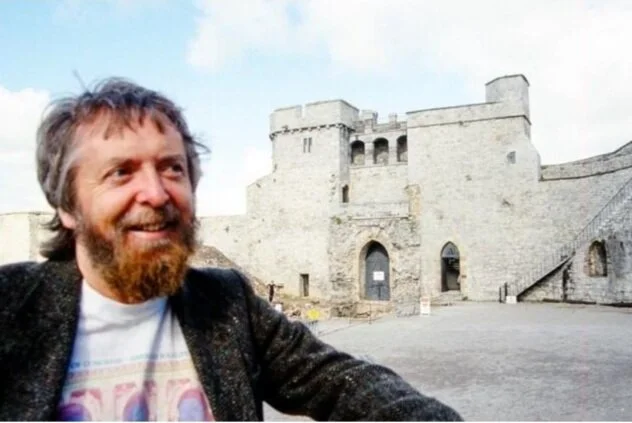
Mick Moloney at King John’s Castle, Limerick, Ireland
Sadly, my remarkable friend Mick Moloney has quite suddenly passed away. So vigorous and passionate about life he was, singing and singing and living off the scale to the last musical note. This Irish wit and raconteur possessed of Druidic powers of memory will be missed in this world. He inspired and entertained millions of people with his songs and his banjo, his recordings and published works, and devoted his research and teaching to the history of the Irish in America and their music—aspects of Irish history and music often ignored.
I had the great good fortune of meeting Mick in the mid-1970’s at An Claidheamh Soluis, (the Irish Arts Center) and later traveling around Ireland on one of his phenomenal musical bus tours. In the early 1990’s it was a new thing, a celebrity tradional musician taking a group of fans to the old country for a tour. Mick was from Limerick, not exactly the most glamorous part of Ireland like Kerry or Clare, with the grand Cliffs of Moher. But Frank McCourt had made miserable Limerick famous with Angela's Ashes. Rain, rain, incessant rain. Because Mick gigged all over North America, it was easy for him to gather recruits. And since it was the beginning of Mick's tour guide endeavor, he could appreciate the publicity an article in Irish America Magazine would bring. So I was invited, to take notes and photographs while cramming in as much music as I could on his Sept.22-Oct. 4, 1993 tour. —Nancy Lyon
Mick Moloney’s Madcap Irish Tour
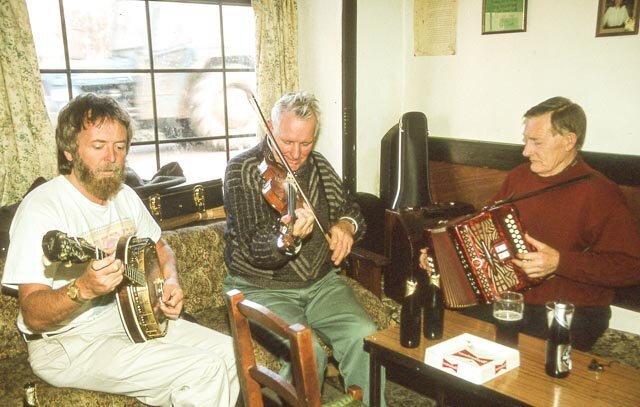
Mick Moloney on banjo, Paddy Cronin on fiddle and Johnny O’Leary on the box in Dan O’Connell’s pub, Knocknagree, Sept, 1993
Off to Ireland!
Like all good backpacking, hitchhiking vagabonds of the late 70's, I hate bus tours. I pride myself on having discovered Ireland through rheumatic stints in thatched cottages in Connemara, damp bedsitters in Dublin, and busking and odd-jobbing around. But when I ran into Mick Moloney at an Irish music festival in New York's Catskills Mountains last summer, and he told me about his folklore tours to Ireland, I gave the bus tour idea a second thought.
Mick always organizes a good show, whether it's plucking his banjo and singing traditional Irish songs, or hauling Yanks around Ireland on a bus tour like no one in Eire has ever seen.
I hate bus tours, but Mick Moloney seems to have elevated this hackneyed form of travel to untold heights of spontaneity and hilarity. Sure it's as if we're only PRETENDING to be on a bus tour.
There were the baggage tags and booked hotels and what-you'd-call an itinerary. But you got the impression it could all be tossed out the window on a whim, and instead of going off to King John's Castle or the Cobh Heritage Center, we could end up in jail!
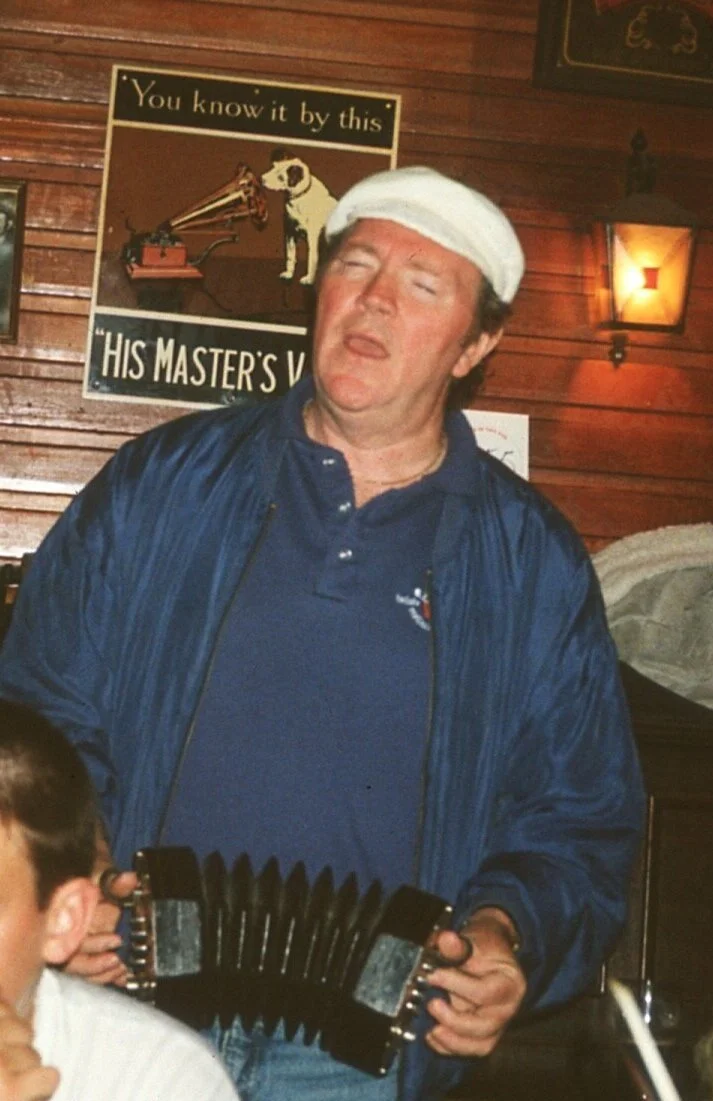
Liam Clancy at Mooney’s Pub
I'm referring to the madcap after-hours raid at Mooney's Pub where Liam Clancy was singing. But what should you expect when you park a huge white tour bus right in front of a lonely country pub? Liam Clancy ducked out the back door, leaving the rest of us, 33 Yanks of various ages and occupations hailing from Alaska to Florida, to be "found on" the premises.
The raid at Mooney’s
We stood there, under the stern gaze of the local Waterford gardai, our pockets stuffed with magic crystals from Skellig Michael and crumbs of Great Blasket Island earth, our legs broken in by romping over bogs to get to beehive clochans and learning to dance Kerry sets at Dan O'Connell's in Knocknagree.
The Prequel
““YOU got bitten by an iguana, Mick? But why in God’s name were you trying to feed it?’’ I tried to imagine the scene: pale-skinned, bearded Gael-with-banjo down in Ecuador with a raggedy group of Irish musicians on an Important Cultural Tour for the U.S. State Department. While Professor Mick Moloney, folklorist, record-producer and traditional musician and singer, was pitching crumbs of enchilladas to an iguana sunning beside a hotel swimming pool, it leaped up for a chunk of his flesh.
Within the same 24 hours, Moloney had been pickpocketed of $700 of the group’s gig money and nearly put in hospital with fifth-degree sunburn. “I was only in the sun an hour and a half,” Mick said. “But I forgot we were on the equator, and there’s no ozone layer. I couldn’t wear a shirt for three days!”
Mick told me all this as the music was blasting away at an Irish folk festival in Leeds, a resort town in the Catskill Mountains of New York. Mick had traipsed around the planet a few times since I’d last seen him performing at New York’s Irish Arts Centre, the reconverted Hell’s Kitchen garage where I learned to play the penny whistle and to pronounce tune names like An Falaingin Muimhneach.
He was going on about his Irish folklore lectures, and how one Californian was inspired to pack off to Kenya to live with the Masai—because he thought they’d teach him to walk like a Druid. And then Mick tried to lure me into his latest venture - hauling packages of Yanks around Ireland in a tour bus.
”Not me! Never!” I swore. Fiendishly proud of my stints in damp Dublin bedsitters and leaky thatches, I blushed to see those bus tours of Yanks landing in Killarney - asking for iced tea in the restaurants, chilled mugs in the pubs, and wearing T-shirts beaming “I Have Irish Roots!”
”But this is a folklore tour’’ Mick protested. “With archaeologists, cultural geographers, historians, storytellers - and traditional music and set-dancing every night. Bronze Age dolmens,crannogs and stone circles, Skellig Michael and the Great Blasket Island - just think of it!”
I thought of it. I was dying to go back to Ireland after nine years away, and tripping around Ireland with this scholar, tale teller, wit and crack musician from County Limerick might be like doing merry old England in a yellow submarine with John Lennon, RIP. Zany and intellectually sizzling.
And so a few months later, On September 23, 1993, I found myself on a daunting loopy, knotted itinerary from Limerick to the Dingle Peninsula, down through Bantry and out to Mizen Head, up to Cork and down to Cobh; through Waterford, Kilkenny and Wexford and up to Dublin.”


We chugged our pints, grabbed our mandolins, fiddles and whistles, piled into the bus, and drove off into the night crooning "My Irish Molly" to an old recording of those 1930's stage Irish entertainers, the Flanagan Brothers—all the way back to the Tower Hotel.
Mick Moloney's ten-day Irish Folklore Tour was a carefully -controlled micro-environment which allows its inhabitants to survive without sleep, while being exposed to Clare fiddle tunes, Bronze Age dolmens and stone circles, rebel and immigration songs, set-dancing lessons, Irish history, politics, cultural geography, folk beliefs and mythology, with tales of Cuchulainn and Balor of the Evil Eye, and essential trivia about the Irish on the Vaudeville stage, including the life and loves of Lola Montez, the notorious 19th century Limerick beauty and third-rate dancer who seduced Hungarian composer Franz Liszt and King Louis I of Bavaria.
Sleepless in Stab City
No ordinary CIE Irish tour bus guide would dare call Limerick by its proper nickname "Stab City." Or chat so candidly about Irish taboos-divorce, contraception, unemployment, the Northern troubles, and the fate of Ireland's gypsy tinkers and travellers. Or entertain you with quirky anecdotes dug up in years of folklore research, musical gossip and diddled-out hornpipes and reels.
You are enlightened daily and nightly by this wit and raconteur possessed of Druidic powers of memory, and his team of archaeologists, cultural geographers, sagacious historians, dynamic dancing masters, storytellers and singers and distinguished poets.
Your nervous system, intellect, imagination, musical ear, thigh muscles and whimsy bone are so phenomenally over-stimulated that you feel like you've crammed a whole lifetime into one week.
Ruination

Beehive huts on Skellig Michael
“Dear Lucy,
I can’t believe I climbed Skellig Michael today. Des Lavelle, author of The Skellig Story asked Mick “What class of Yanks are they?” before agreeing to haul us out in his boat for three hours in a rolling sea to climb the jagged slippery rock path 714 feet up to where those 6th century monks lived in crude beehive stone huts. And Mick said “I’ll ask.”
I think we passed the Intrepid Yank Tourist Test, but we climbed Skellig on a calm day. With any kind of puff in the air, you’d be insane to do it. It’s called “an island of 43 acres—mainly perpendicular.”
Those sixth-century monks had all of Ireland to choose from. Why did they build a monastery on a rock with barely enough soil to stuff a clay pipe? What did they eat? How did they keep from freezing? How did they stay sane with nothing around but clouds and waves and screaming kittiwakes?
This is what we’re wondering as we stumble around the rocks and crude huts, and stare at the jaws of the gaping sea below. One slip and it’s shark bait you are.
”
It's only Day Six of the tour, and already we've conquered Skellig Michael and taken a wild splashy boat ride out from Dunquin to explore An Blascaod Mor, the Great Blasket Island. This lonely windswept bog, deserted since 1953, has produced some of Ireland's most potent folk literature—including the memoirs of Muiris O'Suileabhain, Twenty Years A-Growing, (1933) Peig Sayers' An Old Woman's Reflections (1939) and Peig, (1936) and Tomas O'Crohan's The Islandman (1929).
With Galway archaeologist Mick Gibbons, we've poked around ruins of the island's abandoned thatches and brushed up on our Ogham inscriptions.
At Craggaunowen we walked along an Iron Age road built in 148 B.C. and travelled a millenium back in time to a recreated crannog. The thatched huts of this medieval ring fort look like they belong in Africa rather than County Limerick. But the Irish climate was a tad warmer back then...
We've broken our legs learning to polka with octogenarian champion set dancers at Dan O'Connell's pub in Knocknagree. Explored a bronze age copper mine and the largest stone circle in the land with archaeologist Paddy O'Leary. Filled our ears with Clare fiddle tunes and rebel and immigration songs, tidbits of Irish-American history, Celtic mythology and cultural geography.
Fueled by tunes, tales, great lacks of sleep, and Mick's marvelous musical lore, the gaps in my haphazard knowledge of the Emerald Isle, gleaned from pub repartée and hitchiking from hither to yon, have gotten quickly filled in.
To Imbibe the Old Mysteries of Ireland...
Some of the questions on Mick’s quiz:
“ Who wrote Cuchulainn of Muirtheimhne? [ Lady Gregory ]
How many players are on a Gaelic hurling team? [ 15 ]
What County Clare man is credited with inventing the submarine? [ John Phillips Holland ]
What industry did Charles Walker bring to Limerick in 1824? [ The lace industry ]
What Irish king defeated the Danes at the Battle of Clontarf in 1014? [ Brian Boru ]
What is meant by the term Shelta? [ The language of Irish tinkers ]
On what day does the feast of Bealtaine fall? [ May 1st ]
What U.S. city’s river runs green on Saint Patrick’s Day? [ Chicago ]”

“Dear Maureen,
I’d like to say I’m writing this from Peig Sayers’ old cottage on the Great Blasket Isle, but after our drenching boat ride, I’m happy to be penning this in my cozy room at the Castlerosse Hotel. The Blasket was eerie with the late afternoon sun peering into eyeless ruined thatches raped by the wind. But there was a kookie moment when one of our tour group, an artist from Florida who dresses like a fetching Celtic huntress and talks constantly about crystals and stones circles, grabbed one of the island donkeys and took the beast for a ride. You wondered what kind of eccentrics would be on this trip, well mostly people who’re crazy about Irish music and trust Mick Moloney to show us the Hidden Ireland, profound and profane. So far, he’s doing a bang-up job. ”

Emigration from Cobh, County Cork to the fever sheds of Grosse Ile, Quebec
At Cobh, the Cork harbour which was Ireland's main trans-Atlantic port between 1800-1950, I learned more about the 2 1/2 million Irish who came to North America in steamers, ocean liners, and squalid coffin ships. I had already seen the mass graves of famine refugee victims on Grosse Ile, Quebec where 12,000 Irish died of typhus and cholera in the summer of 1847. It was ironic to see the port from which they had sailed with so much hope.
Oh me legs! If it wasn't the bog tromping, it was the set dancing and the foot tapping, or the walking tours of Ennis, Cork, Wexford, Waterford and Dublin, or crawling under megalithic dolmens to snap photos.
Oh me head! After our crash course in Irish history, politics, folklore, geography and culture Doctor Moloney gave us a 60-question trivia quiz to test our powers of retention...
Months after the trip, the visuals and soundtrack are still rolling in my head. The fiddle tunes of Ed Reavey as we rounded the treacherous Devil's Elbow, and cheered at Willie our driver to drive it all over again - backwards! The biting wind that blew over Vinegar Hill...the twilight with brooding Celtic crosses at Glendalough...Moments with my travel companions like Peter Berry from Seattle, serenading us with his new wire-strung harp made from black sally, alder and 2,000 year-old-bog pine...and Dan the Postman McCarthy, who brought a U.S. postman's uniform all the way from Redlands, California to give to the first Irish letter carrier he saw, and who, one morning, showed up at breakfast proudly wearing an Irish letter carrier's uniform.
'Tis a sure thing-Mick's madcap musical tour, geared for people who hate bus tours, is a unique way to experience Ireland. You won't catch me dead on a bus tour, I said. But now I have to eat my baggage tags.
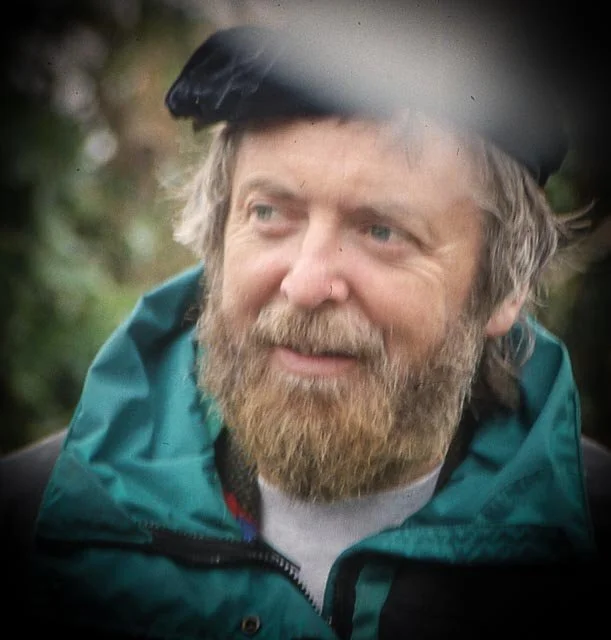
Mick Moloney sporting a beret
“ABOUT MICK...
On both sides of the Atlantic, Mick Moloney was reknowned for his expressive traditional singing and dexterity on the tenor banjo. He performed with Ireland’s greatest musicians and tours with the ensemble The Green Fields of America. Since Mick emigrated from Limerick to Philadelphia in 1973, he’s been recognized for the remarkable output of his contributions to the revival of Irish traditional music-producing or playing on over 40 albums, working on documentary films, organizing Irish music festivals, concert tours, and instructional music workshops all over the U.S.
He obtained a doctorate in folklore and folklife from the University of Pennsylvania, and lectured widely on an exhausting range of Irish cultural topics—all while gigging from Alaska to Quebec, Toronto to Tarpon Springs, Florida, to Nicaragua, Senegal and the Congo.”


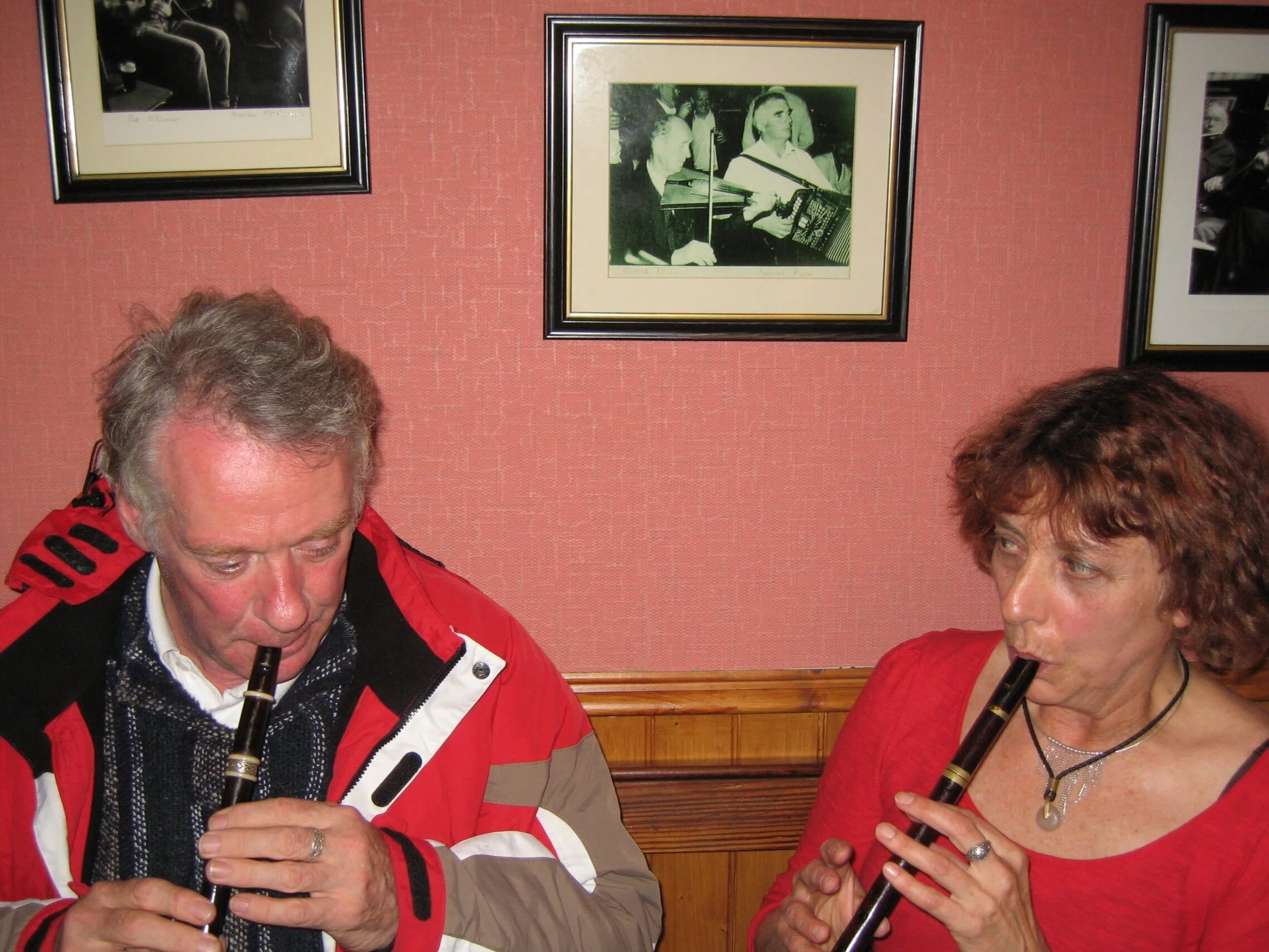
Gordon Mooney and Nancy Lyon at Lena’s Pub in Feakle, County Clare—a great county for Irish traditional music.
THE SEQUEL:
In 2010 I spent a few weeks traveling around Ireland—in a car—with my partner/piper Gordon Mooney. We stayed in a cottage in Feakle, County Clare to enjoy all the great sessions at Lena’s Pub. Something about the pub felt very familiar, and then when I saw one of the photos on the wall, of a sprite old man playing his triangular home-made fiddle, I knew I had been there. It was a photo I had taken on Mick’s tour, that I had sent to Mick and later published in my book Scatter the Mud.
Of course on Mick’s bus tour, all of us had entered Lena’s Pub through the back entrance, where we parked the tour bus. This time, Gordon and I had entered through the front door of the pub. Here we are playing Gordon’s Blackwood “timber whistles” under my photo of the triangulated fiddler!
