
My Friend the Witch Doctor: Voodoo Encounter near Guadeloupe’s La Soufrière Volcano
By Nancy Lyon
You’ll laugh if I tell you that the very first person I asked about voodoo on the isle of Guadeloupe turned out to be a houngan—a witch doctor! But this is exactly what happened…
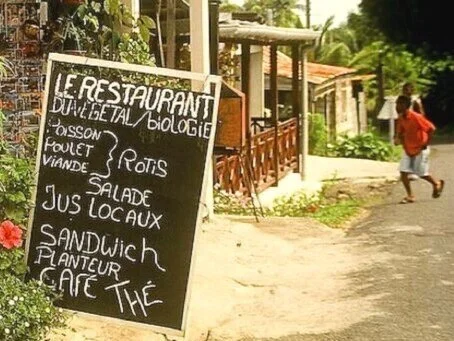
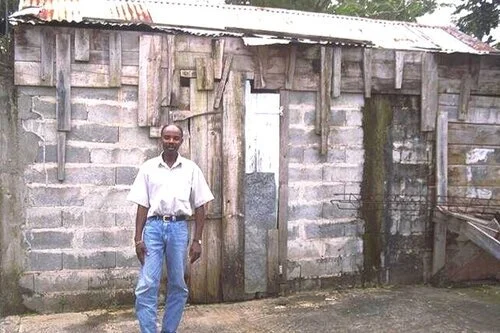
“Restaurant” where I met this Guadeloupe Voodoo doctor,and here he is in front of his Voodoo “clinic.”
“On assignment for Air Canada Magazine to write a story about Christmas in Guadeloupe, I hoped that my travels around this Caribbean island would give me the chance to learn about voodoo. This animistic religion woven with black magic originated in the French Antilles with the African slaves working the sugar plantations. (voodoo means god or spirit in the languages of Dahomey and Togo.) Haiti is the home of voodoo, but I had just read in Gallimard’s guide to Guadeloupe that it was still practiced in Guadeloupe. But I NEVER expected to meet a voodoo doctor, let alone follow him into his “voodoo laboratory” hut...”
Guadeloupe reeks of superstition and voodoo. This Caribbean island which is an Overseas département of France is a hot tourist destination. But beyond the beaches of at Gosier and Sainte-Anne, and casinos in Saint-François, there’s real folklore going on, in villages where the severed head of a black cock means death, and any black dog can be a lurking evil spirit.
Take the town of Morne-à-l’eau. You’re driving into it and you look up to see a strange village of—outdoor shower stalls?—covering a whole hillside. A checkerboard city of black and white and pink and baby blue bathroom tiles gleaming in the sun, vaguely clownesque. What is it?
A Guadeloupe graveyard - as cheerfully colored as a holiday resort, yet macabre nonetheless
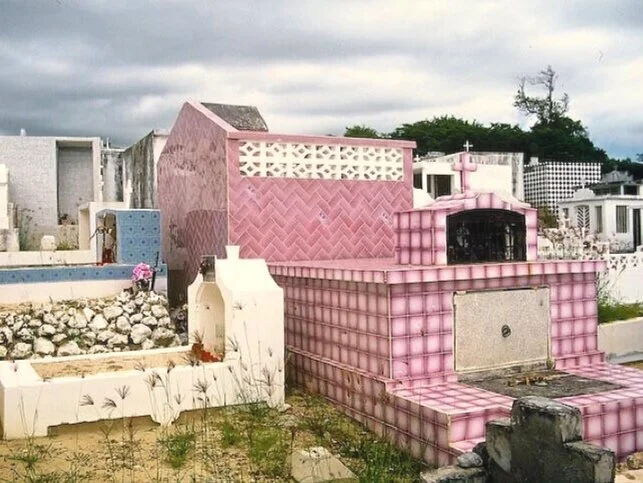

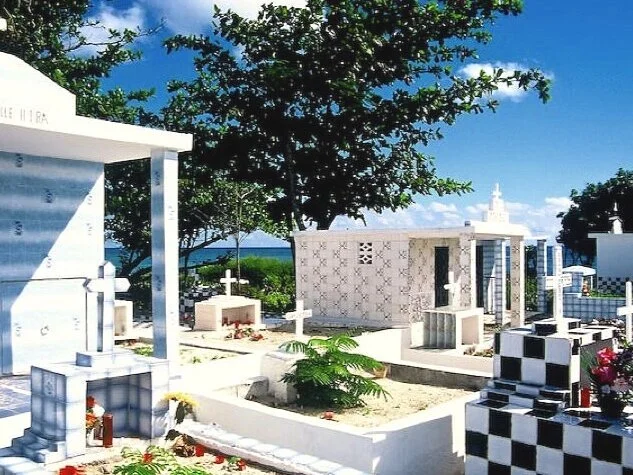
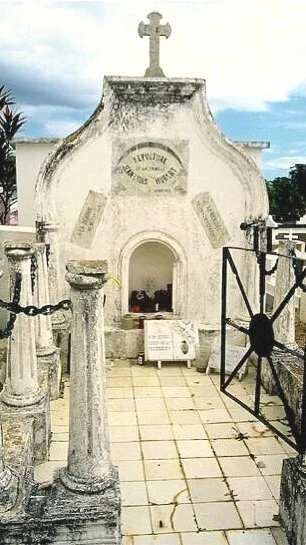
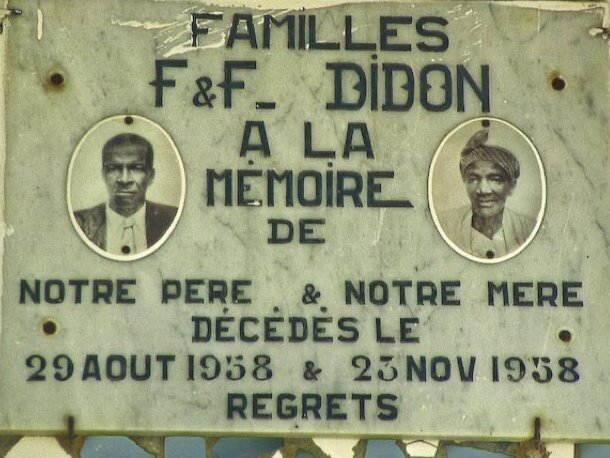
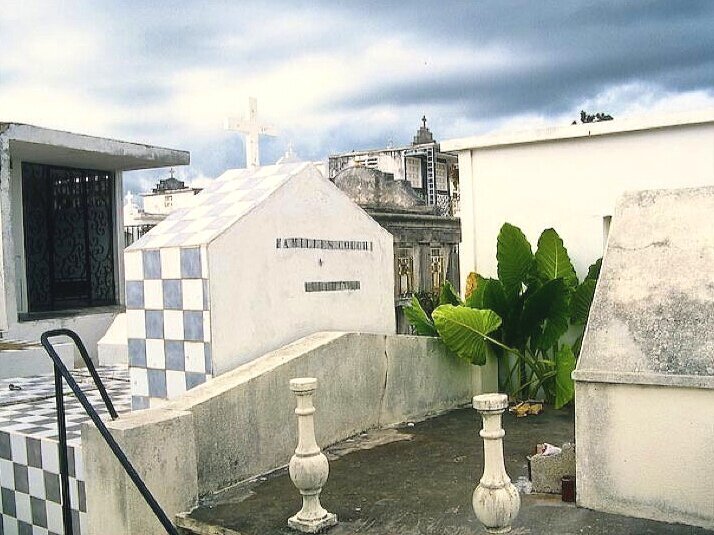

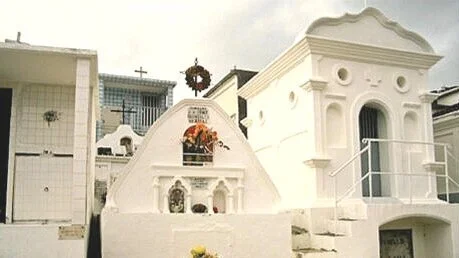
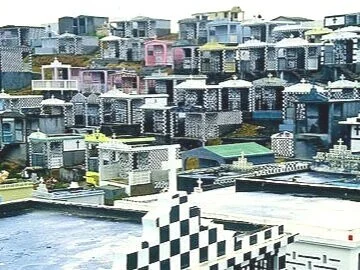
You stomp on the brakes for a good look. Drive your rental into a ditch. Get out with your camera, poke around. Gawk at the acropolis of wrought-iron gated mini-mausoleums, hung with old sepia photos of black grandpères and grandmères in Creole headdress.
The well-cared for residences of the dead in this Guadeloupean graveyard are fabulous, freshly painted, cost more than a house. And among them, much humbler burial mounds of sand ringed by conch shells and covered thick with years of candles melted into macabre puddles of wax.
Fascinating. My imagination was stoked up by Guadeloupe. By the tropical heat, by my nocturnal readings of Interview With The Vampire, by the bloody boudin I had been served the night before, and the banana-sized cockroaches haunting my bungalow. And the Devil’s perfume, the smell of sulphur, from the smoldering La Soufrière volcano.
I stopped in front of a tin-roofed shack and and bought some bananas. The skinny little boy selling them by the side of the mountain road was dancing and waving bunches at passing cars. When there were no cars, he stood behind his shabby table under the banana tree and waited.
Bois bandé
On the other side of the road another boy was standing behind another shabby table, peddling bottles filled with cloudy amber liquids. His mama’s potions weren’t the zingy rum punches I’d seen at beachside bars on Grande-Terre. The big glass jars of dark rums lined up on the mahogany counters of those trendy watering holes were floating with fleshy chunks of cherries, mangos and pineapples. But these village home brews selling for 150 French Euros were spiked with branches of the Richeria grandis tree: Bois bandé. Hard wood. Wood that gives you a hard on.
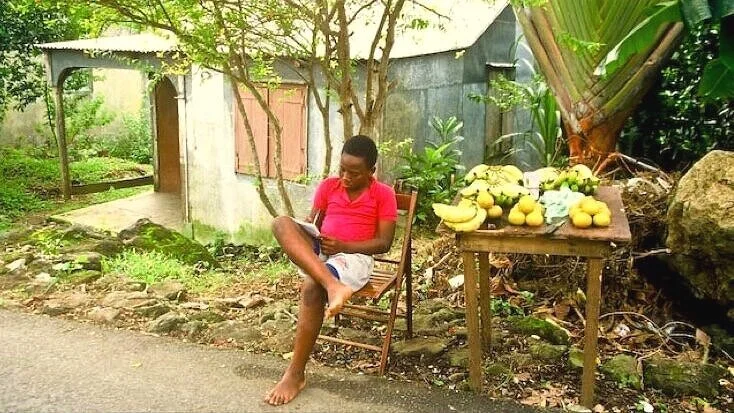
Bananas for sale by the side of the road
Bois bandé is the island aphrodisiac. A botanist I had met in Saint-Claude had told me all about this local aphrodisiac, ground from the bark of the Richeria grandis tree. Bois bandé was such a powerful vasodilator that a certain dose of it could leave a male with a permanent priapism. An erection that wouldn’t wilt even after dozens of orgasms. The botanist has shown me a Richeria grandis tree by the side of the road. The bark of it had been scraped away. Monsieur Maré said without a smirk that there were men on Guadeloupe who, after too greedy a dose, had chosen surgical amputation over permanent torture.
Bois bandé was easy to find. At the outdoor market in the bustling port of Point à-Pitre, I’d seen buxom women in colorful madras plain headdresses hawking little vials of it, along with their vegetables and the waxy phallus-shaped bars of ground compressed cocoa beans. I almost bought a vial as a conversation piece, but I didn’t think it’d make such a smart souvenir to take back home—even if it might slip through customs. Out of embarrassment opted for the chocolate rod instead.
And then I noticed on my map that near L’Habitée there was a pond named Ètang Zombie—Pond of the Zombies! Zombies were no black-and-white B movie joke. They were for real, as a botanist I had spoke to in Sainte-Claude had reminded me. Harvard University ethnobotanist Wade Davis had explored the zombification phenomenon in Haiti in 1982, for the sake of medical science, and it was rigorously complex and unspeakably frightening…
Bois bandé. In French it means "hard wood" —wood that gives you a hard on. On my first day on Guadeloupe in the French Antilles, a botanist in the town of Saint Claude had told me all about this local aphrodisiac, ground from the bark of the Richeria grandis tree. On my second day on the island I saw it for sale.
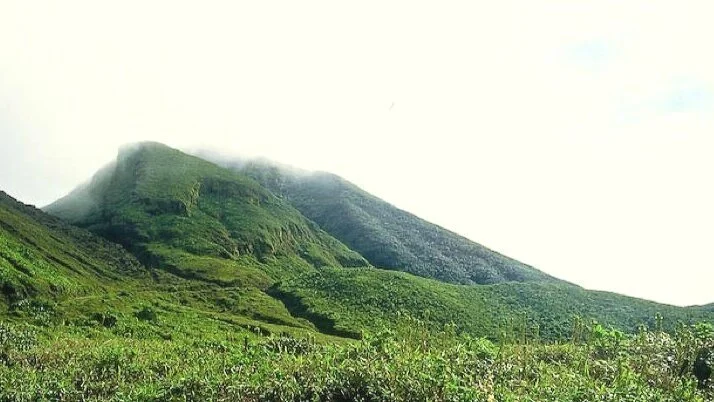
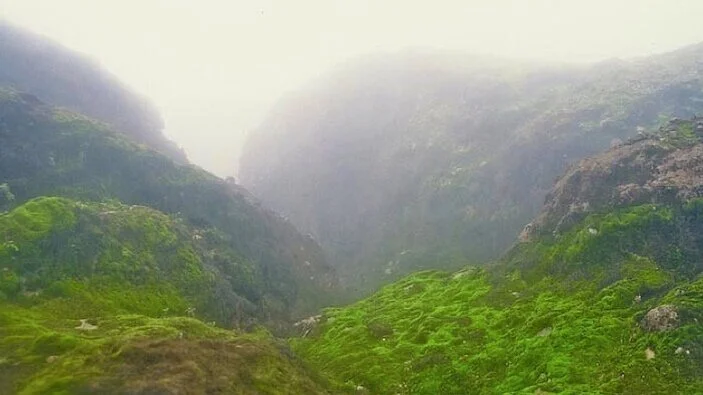
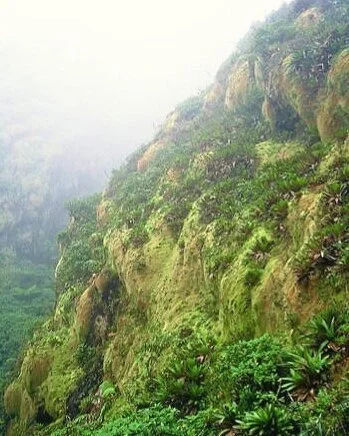
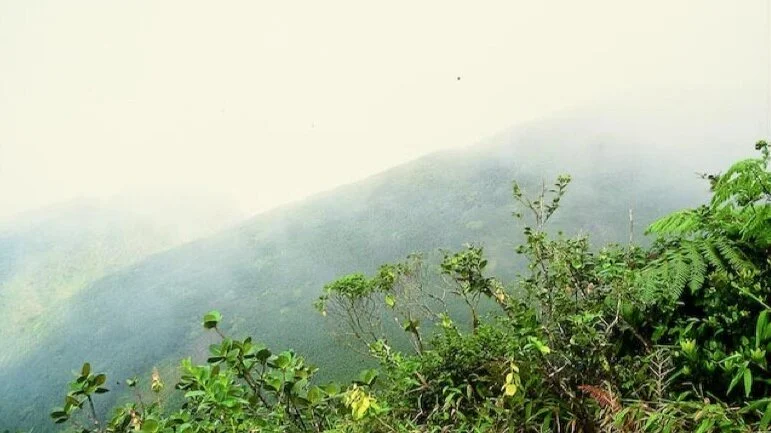
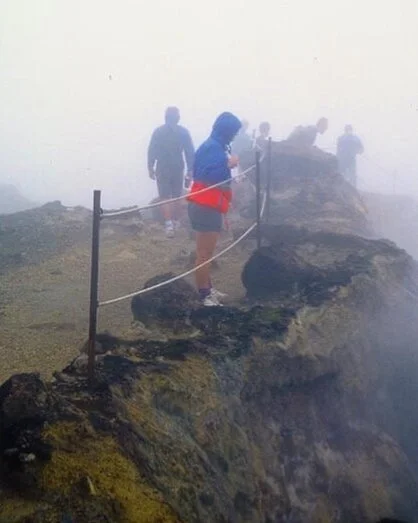
I had just hiked down from La Soufrière, the 4,500 foot volcano which has been smoldering for 13,000 years. La Soufrière erupted disastrously in 1976, but its temper is supposedly under control. Now it's the magnificent centerpiece of the 17,300-hectare Parc Nationale, a cathedral of blooming orchids and flamboyants, tangling lianas and towering redwoods.
The climb up had been ferociously steep, but the excitement of a live volcano fired me on. At first it smelled like a beauty parlor. Then like really rotten eggs. Then near the steaming fumeroles, it was a stink bomb.
Coming back down the mountain, I stopped to rest my legs in the tin-roofed village of L’Habitué. Looking for a cafe, I saw a boy peddling bottles of amber liquids by the side of the road. His mother’s potions didn't resemble the zingy rum punches floating with chunks of fruit sold at beachside bars on Grande-Terre. These dusty bottles of cloudy home brews cost 150 French francs.
"Bois bandé" he whispered. "Non merci" I smiled, wondering how many of these bottles had made it through Canadian customs. Bois bandé was such a powerful vasodilator that a certain dose could leave an eager male with a permanent priapism. One that wouldn’t wilt even after dozens of orgasms. It was said that there were men on Guadeloupe who, after too greedy a dose, had been forced to choose surgical amputation over eternal torture.
Continuing my meander through L’Habitué, I spied an outdoor cantina where loud men gulped rum in the midday sun. I took a seat at a wobbly table and stared up at La Soufrière. My imagination was stoked up by Guadeloupe. By the tropical heat, by my nocturnal readings of Interview With The Vampire, by the boudin blood pudding sold everywhere, and the banana-sized cockroaches haunting my bungalow. Now it was the Devil’s perfume, the smell of sulphur, that got me going.
Pond of the zombies!
I gazed down at my map. The name under a blotch of green leaped out at me: zombie! Étang Zombie—Pond of the Zombies! Zombies were no B movie joke. They were for real, as the Harvard University ethnobotanist Wade Davis had demonstrated in his spellbinding book The Serpent and the Rainbow, written after his studies of the zombification phenomenon in Haiti in 1982. The book and the Wes Craven movie by the same name, were unspeakably frightening.
Maybe he read my thoughts, the dark man sitting alone at the next table. His jaunty smile invited me to chat en français… about the weather in Canada… about the volcano…… and then, I couldn't resist asking.. did he par hasard know anything about…Voodoo?

Thin Toussaint in a rumpled white shirt. Spoke to me now in mutters. About being a quimboiseur with many international clients. What did I want? Love potions? Revenge? Personal power? A hex on the boss? An antidote for jealousy? Jealousy was a big problem on Guadeloupe, he said. He got up from his table. Some beastly curiosity made me follow him down a dusty side road. To a windowless concrete shack smelling of damp earth and smoke. A ragged bed darkened one corner, and a low table draped in blood-red satin occupied another. Toussaint squatted behind his voodoo altar cluttered with objects. He lit a black candle. Then a cheeping sound, like the coqui tree frogs that sang through the Guadeloupean nights, came from under the table.
Grinning, the youthful sorcier grabbed the thin plastic bag pulsing with life. He shook out the black-feathered baby chickadee fighting to escape. He would mash it live into a mortar with other ingredients for a medicament, he explained. If I wanted, he would brew me up a medicine too, for only 300FF. I didn’t have 300FF, I said. And I wasn’t sick, although I was now feeling quite pale.
It was one thing to read about the Wade Davis’ harrowing quest for the ingredients of the Haitian voodoo zombie potion while I was snug under a goosedown comforter in Quebec. It was quite another to be in the presence of a voodoo bokkor who just might have a deadly blowfish around the house. It was the blowfish—the puffer fish—that produced the paralyzing neurotoxin 160,000 times more potent than cocaine and 500 times stronger than cyanide.
Tetrodotoxin: a poison for which there is no known antidote. A certain dose can produce a death-like trance, or kill instantly—which is why Japanese gourmands of the fugu fish sometimes drop paralyzed or stone dead at their chopsticks. The blowfish looks like a balloon from hell, with spikes like vampire fangs and a mouth curled into a sneer. I’d seen a one in a shop at Pointe-à-Pitre with a light bulb shining through its translucent skin and an electric cord hanging out of its tail.
The Voodoo doctor’s potions
Toussaint fumbled a stained and musty book of 19th century Tarot. Now he was playing with the rubber doll and chunks of human bones on the table. He offered me a sip from a bottle of brown liquid suspended with bits of organic debris. It was a “tonic,” he said. And I said No. Non, non, non, merci.
“Ka fé nwé ?-Comment ça va?” Toussaint asked, as the cheeping black chickadee hopped onto the table and he stuffed it back into the sack. Then he took out his Haitian passport and asked with an air of knowing the answer... On parle le français au Québec? Speak French in Quebec? On mange bien?” "You eat well"?
He had always wanted to immigrate to Canada, he said. I said that I didn’t think “Sorcier en Voodoo ” would exactly qualify as a profession, forcing a laugh. Then as the black candle dripped, he babbled on in French mixed with musical Créole—the bouillon of French words, African syntax and Caribbean rhythms. About the “craft” he had inherited from his parents…
From an early age they'd seen he had "the gift." They taught him magical incantations in Créole and French, and he took part in their magic ceremonies. He went into trances, held seances with spirits, mastered the magic symbols and rituals, how to concoct all the potions, powders and philtres from secret ingredients procured in Haiti.
“La magie noire ou la magie blanche ?” I asked bluntly.
“Les deux" -- both-- he replied.
“Do you kill people?”
“Mes parents sont encore en vie... my parents are still alive. I have to be very careful. Avoid revenge. Mais, oui, il faut tuer les gens des fois.”
Yes, sometimes he did have to kill people, he said. But most of his work, mundane as it sounded, was with marriage problems. Spells for potency, desire and boredom. Spells for jealousy. He could even break up marriages, he said. If I desired a man who belonged to another woman, he could prepare me a boulot. It only took 21 days and $6,000 and it came with a guarantee.
Toussaint offered to concoct me a perfume with special powers. Wearing it would make men my slaves. The ingredients were complicated to obtain. He opened a little black bottle. A vile stench burst forth. I gagged at the smell, impossible to describe. Toussaint laughed at my disgust.. He said he could disguise the magic mix with a knock-em-dead perfume. For only 300 francs.
Gotta go, I said. Gotta work on my sun tan. Try my luck at the casino, or at a cockfight. Maybe I’ll win 300 francs and maybe I’ll be back. And as I got up from the table, said a quick adieu and bolted for the stable door, Toussaint reached over his head and with a smile that could have lit up the dark side of the moon, offered me un souvenir de la Guadeloupe -the funnel-shaped straw basket hanging over his voodoo altar.
Now the odd-smelling basket is hanging on the wall of my studio in Montreal. If straw could talk, I wonder what tales it would tell. And I wonder… should I have bought the voodoo perfume, and a dose of bois bandé to go with it? It’s winter in Quebec, and the best time for sex.