

Irish Traditional Music
“In June of 1984 GEO commissioned me to write this article on Irish traditional music—a dream for a writer whose passion for the tin whistle had lead her to explore Ireland from Tory to Sherkin by bus, train, bike and thumb. Traveling with spirited and gifted photographer Jill Freedman, RIP, was an experience of a lifetime. Sadly, she and Micho Russell, Liam Weldon and Breandan Breathnacht have passed on the the Great Ceili in the Sky. I am so grateful for all they gave me and all they shared with me. ”


December 1984 GEO Magazine article by Nancy Lyon - photos by Jill Freedman

Miltown Malbay, County Clare, 1984
Drowsy Maggie was there with the Rakish Paddy and the Lilting Banshee and the Cow That Ate the Blanket, and all the other great old Irish tunes you could think of. They blasted from bagpipes, wheezed from melodeons and thundered off the goatskins, at all hours godly and ungodly, until you'd think the musicianers would perish from exhaustion. But no. Not when they'd waited all year and dusted off and polished up every jig, slip jig, hop jig and fling, patched the leaky concertina or fiddle the mice had been at and come from every country and locality from Derry to Wexford, New Zealand to Amerikay.
Like hearty camels thriving on liquid reserves, they were going without sleep, food, bathing, thinking--galloping through centuries of Irish traditional tunes without so much as a stumble.
It was the twelfth Willie Clancy Summer School of Irish Traditional Music in Milltown Malbay, County Clare. But for the players, dancers and songsters, it was the annual reunion: Clare men back home from London and Brisbane to play with the boys who never left; Aran Islanders with mainlanders; Catholics with Protestants; Californians with New Yorkers. Irish musicians, dancers and songsters from every Irish locality and foreign clime where this music is played had journeyed to this breezy seaside town—by jet plane, donkey cart, bicycle, hitch hike and on Shanks Mare, the old two feet.
And now they were all squeezed into pubs, gathering at street corners, and scattered among the tents, playing tunes learned and swapped in any of the thousands of Irish watering holes madly scattered around the globe.
It was an odd glomeration of scruffy bearded lads and freckled kids toting tiny fiddles, doting grandparents, swarthy Bretons sporting lavendar foulards, “foreign wimmin” with wild hair and skimpy tops, fair colleens, wide-eyed Yanks and old farmers with tweedy caps. An odd traffic jam of tractors and hay balers, rental Renaults and clunky Morris Minors, chip vans, caravans and donkey carts, rickety black push-bikes and flashy Peugeots with purple panniers.
The sun beat down and lit up the pint glasses perched on window ledges outside the packed pubs. Snow-white breasts got burnt; barrels of porter emptied fast to slake the thirst; and the miraculous heat fused the scents of new-mown hay and ocean spray, dung, turf and tobacco, sweat, vinegar and chips, burgers, strong tea and Guinness into one uniquely Irish aphrodisiacal essence.
In grassy fields all around the little seaside town the steel-ribbed birds had landed, sunk in stakes, and spread their rip-stop flaps and zips. At the edge of this day-glo tribal village, near a stone wall nuzzled by curious cows, I pitched my old orange tent.

Nancy Lyon with wire-strung Irish harp and Photographer Jill Freedman on assignment together for GEO Magazine - after hours.
Set Dancing Delirium
It was stupefying to see how far the madness for Irish music had gone since the folk revival of the late Sixties. In 1974, when I saw the Willie Clancy School in its second year, it was a rather sedate operation. It attracted mostly those fanatics devoted to the cantankerous uilleann (ill-ee-un), or “elbow" pipes, the native bagpipe contraption that can be a hive of honeyed sounds or a sack of screeching cats.
Now there were classes and lectures on tin whistle, fiddle, concertina, Irish harp, sean nos (old-style) singing, set dancing, storytelling and songs of the itinerants, as well as specialized evening recitals.
In the community hall the august Breandan Breathnach, tune collector, scribe, raconteur and chairman of the society of bagpipers, Na Piobairi Uilleann, was holding forth on the origin of Irish bagpipes and discoursing on the music of the late revered king of the pipers, Willie Clancy, RIP, of Milltown Malbay.
At the other end of the town two black-leathered orange- and green-haired Liverpool buskers were spinning out some newfangled hornpipes for a spellbound street crowd. But the wonder to top all of this was the new delirium for set dancing.
There were Kerry sets in one pub, Galway sets inanother, and anyone who couldn't do them was mad to learn. Five-year-olds and 50-year-olds, Swedes, Bretons, Brits and Gaels were signing up for Joe and Siobhan O'Donovan's daily three-hour-long classes in quadrilles.
Packed pubs
Every evening the pubs were packed to standing room only and locked up by seven. Every evening I came out of the recital, inspired oramused to have seen 10 concertinas or 15 wooden flutes on one stage, and found myself locked out of all of them. All but the dim and divey Milltown Tavern, where you could dance corny waltzes and for 50 pence buy a chance to win a calf (tethered outside the door) or a carton of fags.
I consoled myself with the thought that I had a better seat for the circus at my tent in a field behind the church. From the comfort of my goose-down bag I could hear Joe Burke's rollicking accordion soaring above the clamor in the Central Hotel and Mary Bergin's wild bright whistle breezing from Queally's.
In the camping field, the sun popped over the stone wall at 5:00 A.M. , and if that didn't wake you, it was your neighbor practicing his piping or the two Germans who lived three feet away singing some sappy song about Dublin in fake Dublin accents. You always knew when it was 9:55 a.m.—one crowd with instrument cases was off to class, and another crowd with puffy faces was off to Lourdes for “the Cure”—the hair of the dog that bit them the night before.
The week steamed on
The week steamed on. You didn't dare miss the supergala all-star five-hour grand finale concert of "Leading Traditional Artistes"—the Cuil Aodha men's choir singing hymns and drinking songs in Gaelic, a parade of Irish music champions, and old Tom Lenehan, with his pale scarecrow eyebrows, and huge ears, big suit and collar and wide tie singing "Farewell to Miltown Malbay" in a trembling falsetto voice.
The spirits of the hallowed departed musicians were there, and everyone could be allowed a lapse into sentimentality. No one guffawed when crusty Clare fiddler John Kelly said in tribute to Willie Clancy, 11 years gone: "Like our Lord on the cross, Willie died for the emancipation of Irish music. This hall is filled with people from all the great countries of the world, learning our music—all because one great man died."
I freely confess that the whole epic week made me yearn for a winter's evening in a quiet old pub smelling of wet wool and turf, when the blood flows at a nice lilting tempo and the tunes flirt with one another, nice and easy like, and you can hear them without all the brawling, shouting, ranting, roaring and cavorting that the tourist season inspires. But whatever there is to be said about it—and even if Irish traditional music has its stars and groupies and glamorous trappings—the people who play it still act like one big family.
No matter if the Chieftains have played on the Great Wall of China. When they're back home they're down at the local for a jorum of porter with the lads and a few rounds of "The Maid Behind the Bar" topped off at closing time with the Irish national anthem. Whatever else Irish musicians may be, they're accessible.
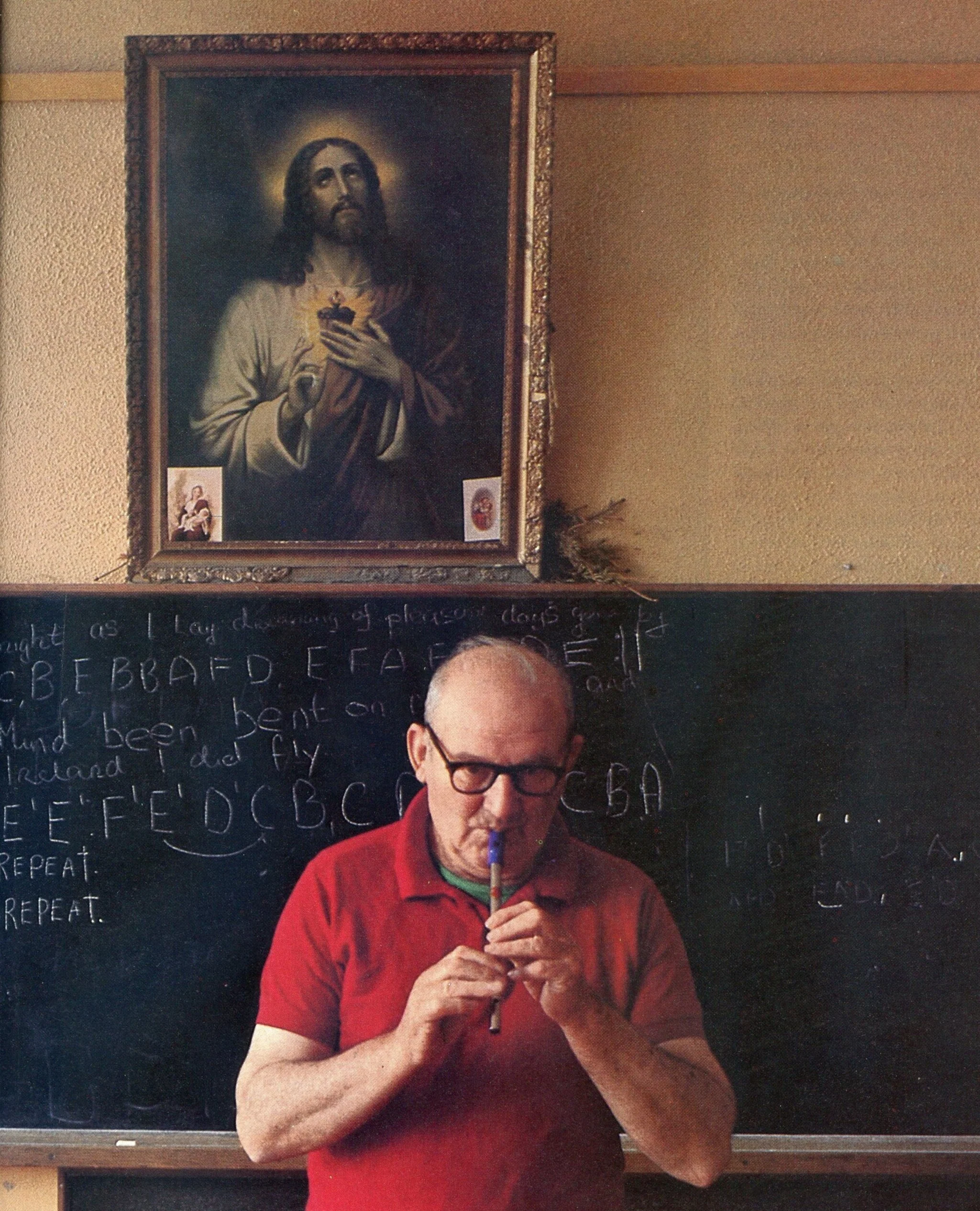
Micho Russell, RIP, teaching a tin whistle class at the 12th annual Willie Clancy Week, Miltown Malbay, County Clare, Ireland. Photo by Jill Freedman.
Micho Russell, tin whistle and flute player from Doolin, County Clare, was as much a tourist attraction in his own village as the nearby Cliffs of Moher. Germans, Dutch, French, Canadians, all packed into Gus O'Connor's or McGann's to hear and play with Micho because to them he is an anomaly: a farmer who got swept into the frenzy of the Irish music, revival yet stayed simple.
In Miltown Malbay people were coming to Micho’s whistle classes for the sheer magic of them. One morning I walked in to find him standing at the blackboard under the portrait of the Sacred Heart of Jesus, chalking out the notes for "The Heathery Breeze."
He cocked his head in his usual way and looked heavenward, as if the notes might be written on a scrap of cloud. Then he smiled a toothy bashful grin and said, "The heathery breeze is some kind of fairy wind. Seanain gaithe is the Irish word for it. "tis some kind of a wind that comes along and roots the grasses up out of the ground." And he listened patiently as each of his pupils tooted out the notes of the reel.
Micho Russell: Songster & Whistler
County Clare was concertina country when Micho was a youth in the 1920's, and in Micho's long cliff-hanger notes and sudden stops, you can feel the press and draw of the little bellows. By the 1930's the concertina had replaced the uilleann pipes as an essential piece of household furniture. Micho's mother and aunt both had played it, as well as his brother Packy. Micho's father and two sisters were fine sean nos singers, and Gussie played in session around Doolin, Lisdoonvarna and Ennistymon.
Doolin has changed so much since Micho picked up his first Clarke whistle at 11 years of age. It was a thriving fishing village and hive of music then, with Aran Islanders rowing over in their curraghs to sell fish, play tunes, and dance "mad fast" as Micho says, in the old Aran hop jig style. Now the little place is a buzzing swarm of backpackers, and in this new milieu Micho sometimes looks out of place in his own village.


Johnny O’Leary: Sliabh Luachra Box Player
"In Sliabh Luachra the men live to be a hundred, and the women never die." That's what they say about that charmed country around the Cork-Kerry border, and two of the reasons are Johnny O’Leary's music and Dan O' Connell's pub. Every weekend box player Johnny O’Leary pours out giddy polkas and slides for the ladies and gents who dance the sets in Dan O'Connell's. Most of them are topping their seventies and eighties now, but they are only in their prime, like one thrice-married woman who was overheard to say, "Sure 'tis as easy to say prayers for three husbands as for two."
Mary Bergin: Tin Whistle Champion
"There have always been women in Irish music," Mary Bergin says, "playing concertinas in Clare, fiddles in Kerry, singing in Donegal and playing pipes in ceili [dance] bands. When the crossroads and house dances were banned in Ireland following the Public Dance Halls Act of 1936, the music moved into the public houses and women became less visible."
But Mary Bergin has always been visible. She was one of the few females who played in pub sessions during the late 1960s, and for years it has often been said that she is the best tin whistler in the land. Her fast spill of clear notes is a thrill—living proof that the humble tinwhistle can hold its own with the heavy-weights: the pipes, the fiddle and the box (accordion).
Dublin has always been a musical crossroads for regional Irish music styles, and Mary grew up playing with musicians from all the counties. Her music,to use her friend John Kelly's terminology, has a "mixum-gatherum" qual-ity. She has the Sligo flow, the Galway punch, the Donegal syncop, the Kerry snap and the Dublin flash. Mary was raised in a musical Dublin family: her father played melodeon, her mother fiddle, her brother guitar and her three sisters harp, whistle and bones. But the young Bergins were learning their first tunes in the days when Irish traditional music wasn't so popular in Dublin, and Mary and her sister Antoinette had to fend off remarks about the little piece of tin with six holes and the Irish harp.
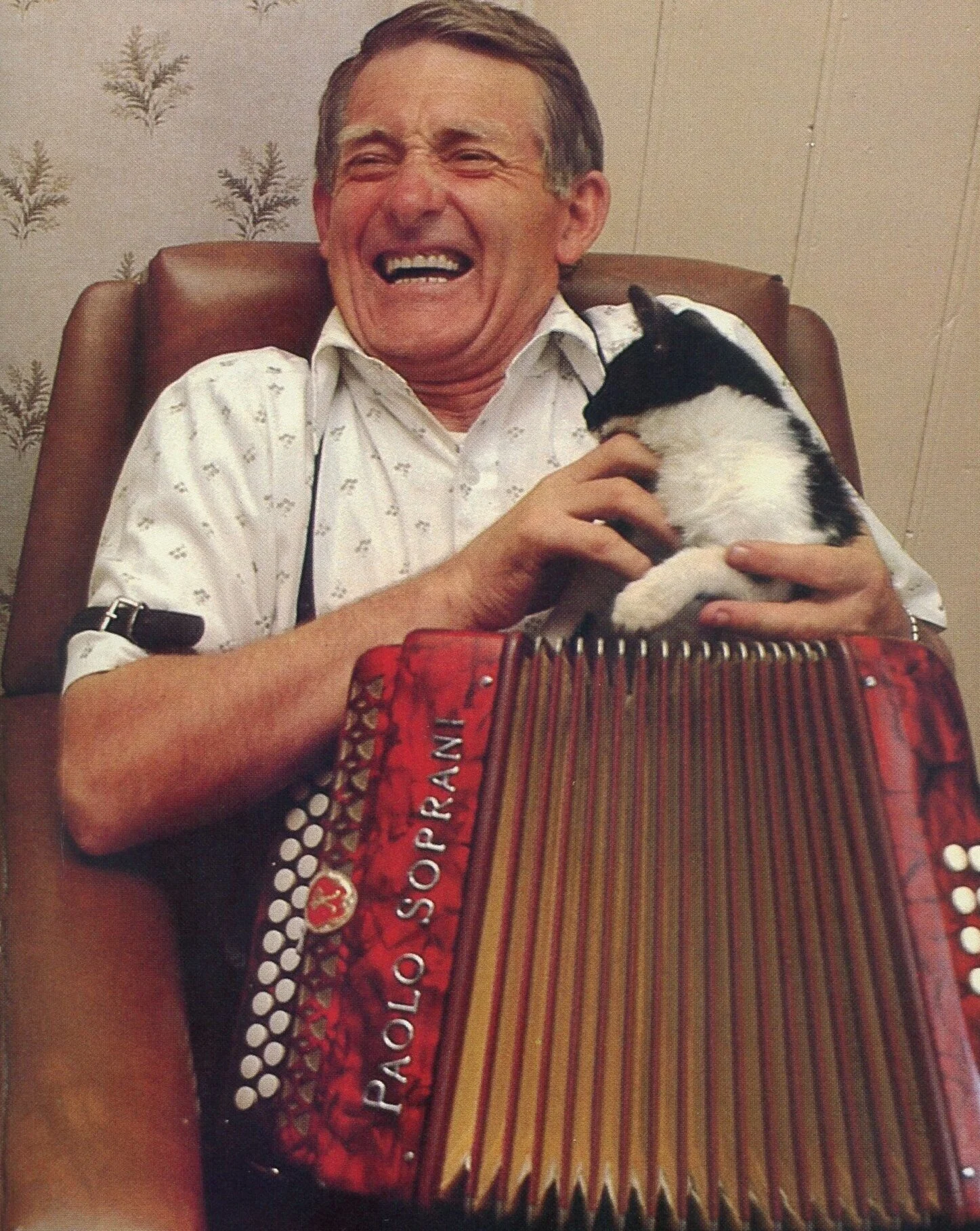
Johnny O’Leary at home in Sliabh Luachra, on the Cork-Kerry border. Photo by Jill Freedman
And there was Tom Billy Murphy of Ballydesmond, the blind and lame fiddle teacher who traveled the region on a donkey, and had such an ear that he could tell the crowd that was out dancing by the battering of their feet. "He was tee-totally blind," Johnny exclaims. "Yet if he'd meet ye, he'd know ye forever agin' by your footsteps. He'd salute ye and call ye by name. Whatever was in it I don't know, but 'twas there, whatever it was."
Johnny O’Leary was born “at a very early age” in Mauly-keavane between Gneevgullia and Killarney. He started out in life with a small 10-key melodeon and by age 13 he was playing in local dance halls with the master Denis Murphy. Then as now, Johnny would do anything to get to a session of music. In those days it was tie the accordion on his back, grab the donkey from the field and hobble to Ballydesmond.
"This is the land of youth, the Tir na n'Og of the West," says Dan O'Connell, who at 70 has a gorgeous pair of legs to prove it. He swears there's nothing like the dance to keep a body young and merry, and that's why he started up his dancing pub in Knocknagree 20 years ago. In truth he's doing God's work as much as the priest who ties the local knots, for his venue has given local widows and widowers a second and sometimes third lease on life.
Many Irish musicians can't rattle up a tune for a step, but Johnny O’Leary isn't happy playing without the foot noise; the music just isn't the full shilling. Johnny comes from a long tradition of players for the dance, among them the mythic fiddler Padraig O'Keefe (1888-1963) who taught John Clifford, his wife, Julia (Murphy) Clifford, and her brother Denis Murphy, whom Johnny played alongside for 38 years, and was wont to say whenever a microphone was produced, "take that gander's neck away from me!"
Now Johnny plays a Paolo Soprani diatonic button accordion with the two rows tuned in the of keys C# and D (unlike most modern players who play B-C instruments.) Johnny Leary is the Sliabh Luachra guardian of that wonderful repertoire of brisk and lively polkas and slides.
Other accordion players like Denis Doody and Jackie Daly have taken the tunes far away from home, where they have spread delight. But Johnny isn't one for gigs and tours himself, and prefers to play for local house dances or roam between O's Peter and Callaghan's in Gneevgullia, Scully's in Newmarket, Jimmy O'Brien's in Killarney, and pubs in Millstreet, Ballydesmond, and Scartaglen.
Johnny loves his polkas and slides, but can turn a jig or flake a out reel with the best of the, and is quick to pick up a tune from any travelling stranger if it strikes him.
Today Johnny and his wife, Lil, who dances and laughs a lot, live in Gullane in a tidy house within admiring distance of the rolling Da Cioch Danann, "the breasts of the goddess Dana." Since he retired from his job as a fitter in the Fry-Cadbury chocolate factory outside Rathmore, Johnny has more time for the younger players who collect around him, and he loves to acquaint visiting musicians with the locals. Warmhearted and garrulous, Johnny is a teller of fabulous yarns and bawdy jokes, and the crack (essential Irish slang for a roaring good time) around him is always fierce.
Liam Weldon: Traveler, Song writer, Mystic
"I play on an old tambourine with the Broken Glass Ceili Band in Ballyfermot—that's a quaint little fishing village in Dublin where they fish for transistor radios and TV sets," explains Liam Weldon to a rowdy or bored or sleepy audience. And if that doesn't stir them, he's got another outlandish remark handy.

What would the Irish Tourist Board say about Liam's house? That it's folkloric? There are 35 canaries living in an upstairs bedroom. The front garden is a jungle of roses. The back garden is an orchard, vineyard and menagerie with fig, pear and apple trees, a big fat rabbit, a dog, quail and native finches, chickens, a prized golden pheasant and a kind of mad scientist's shed where Liam keeps a fire going for the grapes and performs experiments on goatskins and steamed oak to make his bodhrans (Irish goatskin drums).
The Weldon family civil war is over territorial rights: Liam's grapevines versus his wife Nellie's clotheslines. No one—not even Nellie—would deny that Liam Weldon is a character. But he's also a vital force in his turbulent community, a deep thinker and champion of the itinerants, or travelers, and the father of eight kids who adore him.
The Mystic of Ballyfermot
The "mystic of Ballyfermot" is a master of the old Gaelic weapon satire, a singer of traveler songs and a writer with a gift for stunning images. Liam Weldon was born in 1934 in the Coombe in the heart of the Dublin Liberties at a time when every yard had squealing pigs and fighting cocks and racing greyhounds, and every street had its old ones on the corner hawking racing tips and ballad sheets and Dublin bay prawns “live and leppin.”
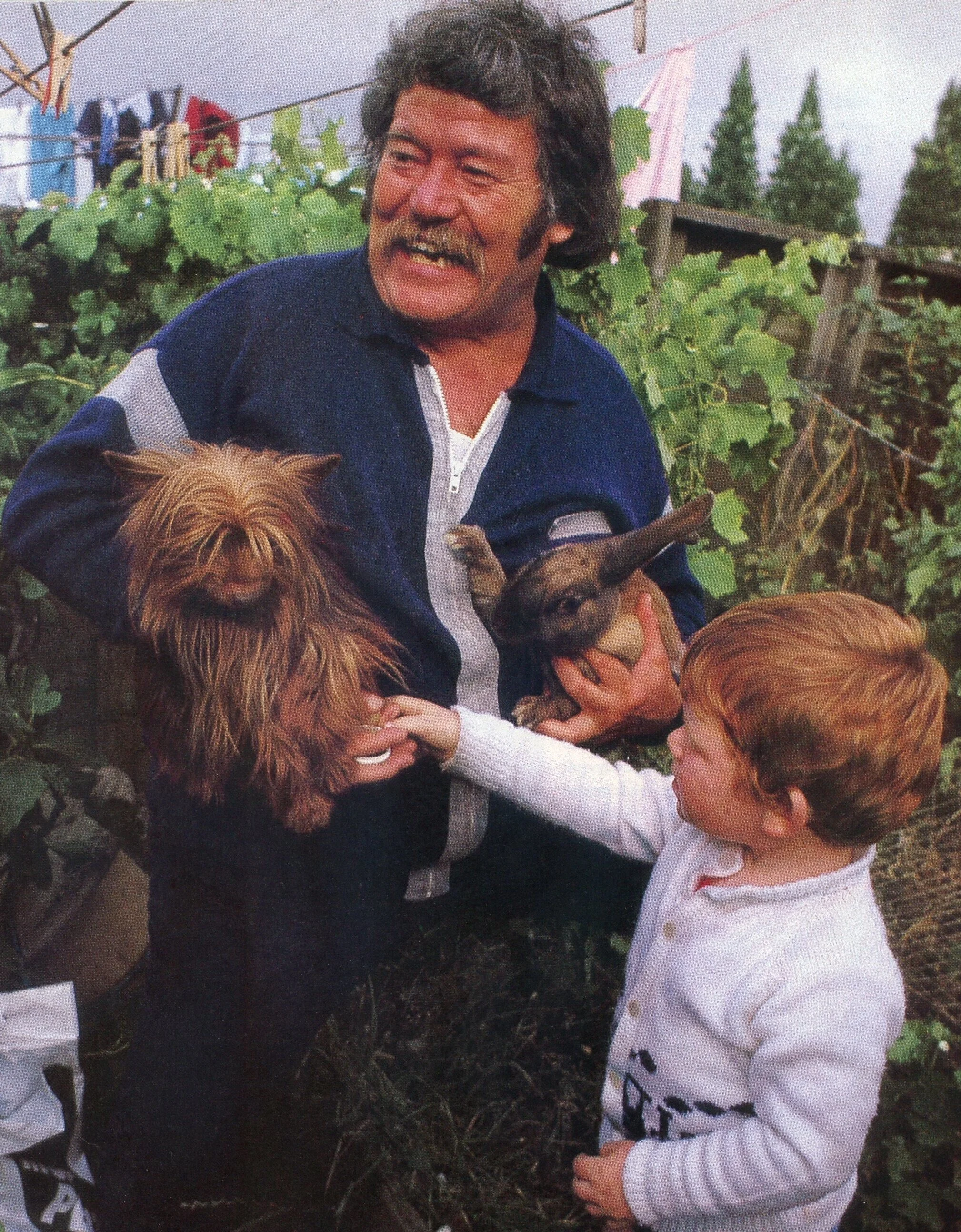
Liam Weldon at home in Ballyfermot Photo by Jill Freedman
“If you were the restless sea, and I the steadfast stones
You the waving kelp above, I the bleaching bones.
Your little waves to lap my feet,
Advance and kiss, encroach, retreat.
Surround, submerge, at last complete,
Oh you and I truly one. . .
And were you then a yellow bloom, dancing in the grass
I a hunting bee, pausing ere I’d pass
As I’d sip your nectar sweet, your pollen grains surround my feet,
In that estatic moment, meet, oh you and I truly one.
And were I then a single seed of all the millions in the field
And you a gentle raindrop from the sky
As you’d fall upon my breast
to awaken me from my long rest
In that moment by the old gods blessed,
Oh you and I truly one.
And were you then the last wilting leaf on the autumn bough,
I the wind a wanton teeth to blow as I blow now
And when you’d fall as fall you must,
I to be the waiting dust,
Beyond sorrow, pain or lust.
And to lie forever truly one. ”
Liam's granny lived on Hanbury Lane, and his father used her backyard to breed his racing greyhounds. At night the travelers would gather there and build their fires, and young Liam would sit bewitched by the smoky faces and ribald songs and laughter.
Today he sings their traveler’s songs in a voice that makes you feel the wet nights and uncertain days in a travelers' caravan, and the spirit that broke through it all. Liam sings preposterous story songs about a pair of red knickers or smuggling the tin, nonsense songs and children's songs, and songs of his own composing, such as The Blue Tar Road about the plight of the traveling people, the “travelers.”

His voice has an uncanny range of tone, from the brittle and metallic to the pure and monastic. Without the clutter of an instrumental backup, it goes right to the bone. He performs at The Brazen Head and in folk clubs around the country, taking the stage with Pol Huellou, the Breton with an ethereal touch on flute and whistle; Sean Howley, who plays a strong bouzouki; and Bernard Harris, who plays harmonium, harpsichord and organ. The group is called Elixir, and no doubt that is what it is, a magic concoction of sounds to "Banish Misfortune," as the jig does, and to prolong life.
For the people who play it, dance to it and love it, Irish traditional music is a remedy for all ills. As the late Galway accordion player Joe Cooley said, "'Tis the only thing that brings people to their senses."